




Our View
- JAAA is the reference product in tokenized AAA CLOs: the largest and longest-running fund in the category, onchain since July 2025 with $687M in assets, run by the same Janus Henderson team that manages the $25B+ JAAA ETF.
- We like the demonstrated exit capacity. The fund has processed some $665M of gross redemptions through its primary queue since inception, including a $318.6M single-day exit (42.8% of AUM) processed with no NAV impairment, and 90% of redemption requests since April 2026 have settled within one business day. There are no formal daily redemption limits.
- Best fit is the floating-rate credit sleeve of a conservative vault: near-zero duration, SOFR-plus carry, a 0.22% worst drawdown over the fund's life, and the only tokenized AAA CLO live as collateral on Aave Horizon.
- Watch out for holder concentration and cost. Two anchors hold about 93% of supply, Grove around 57% (with 37.7% in a single Avalanche wallet) and Ethena around 36%, across just 33 holders in total on all networks; and the fee stack runs a 0.50% management fee, raised once from 0.40%, plus fund expenses recharged without a cap, currently around 6 to 7 bps (issuer confirmation, August 2026).
- Vault Street holds JAAA in primeUSD.
Summary
JAAA is the Janus Henderson Anemoy AAA CLO Fund, a tokenized BVI professional fund investing in AAA-rated collateralized loan obligation tranches. Each token is a fractional interest in a participating share of the fund's segregated portfolio, direct legal ownership under BVI law, settled and transferable on public blockchains. Janus Henderson Investors US LLC, manager of the $25B+ Janus Henderson AAA CLO ETF (NYSE: JAAA), runs the book as sub-investment manager using the same portfolio team and a mandate benchmarked to the ETF's methodology. The fund is the first and largest tokenized AAA CLO product, with $687M in assets as of 3 August 2026.
Key parameters at a glance
| Parameter | Value |
|---|---|
| Legal form | Segregated portfolio of Anemoy Capital SPC Limited, a BVI segregated portfolio company incorporated 18 August 2023 (BVI company no. 2130465) |
| Fund inception | Legal inception 1 May 2025; first on-chain NAV strike 28 July 2025 |
| Regulatory status | BVI Professional Fund recognised under SIBA; not subject to FSC supervision or the investor-protection requirements applicable to Public Funds |
| Eligible investors | Professional Investors who are not U.S. Persons (as defined under Regulation S) |
| Minimum investment | US$500,000 (operational minimum per the issuer); the Memorandum sets a US$100,000 legal floor |
| Investment Manager | Anemoy Asset Management Limited (BVI Approved Manager) |
| Sub-Investment Manager | Janus Henderson Investors US LLC (SEC-registered); PM leads John Kerschner, Jessica Shill, Nick Childs |
| Directors | Martin Quensel, Anil Sood |
| Fund Administrator / Transfer Agent | Trident Trust Company (Cayman) Limited (registrar, NAV calculation, KYC/AML, whitelist); confirmed by the issuer as the administrator for JAAA, operated from Trident's Cayman office (August 2026) |
| Custodian / Prime Broker | JPMorgan Chase Bank, National Association |
| Auditor | MHA Cayman (CIMA-approved) |
| Oracle | Chronicle (Proof of Asset) |
| Wallet infrastructure | Fordefi (MPC) |
| Underlying | 100% of total assets in cash, cash-like instruments and AAA-rated CLO tranches; repo permitted for liquidity and management purposes; no leverage, hedging, or derivatives |
| Fees | Management fee of 0.50% per annum ("Fifty (50) basis points per annum based on the value of the net assets of the Portfolio"), plus fund-borne expenses recharged to investors (variable, uncapped; 6 to 7 bps at current AUM per issuer confirmation, August 2026) |
| Ratings | Particula AAA (token issuance rating, November 2025) |
| Blockchains available | Ethereum, Base, Arbitrum, Avalanche, BNB, Monad, Pharos (protocol spoke chains), plus native escrow-backed issuances on Solana and Stellar (issuer confirmation, August 2026) |
| AUM | $686.9M per the Centrifuge pool page, 3 August 2026 ($685.0M token-side: 656.8M tokens at $1.0429248 NAV per token; the $1.9M gap reflects reporting-pipeline timing) |
| Settlement | Contractual three Business Days (BVI and US banking days); T+0 available for both subscriptions and redemptions with a 10am ET cut-off and T+1 with a 3pm ET cut-off (issuer confirmation, August 2026); subscriptions observably settle T+0 on business days |
See what's moving before anyone else
Get our insights on RWA strategies and onchain yield, straight to your inbox.
By subscribing, you agree to receive product & research updates from Vault Street in accordance with our Privacy Policy. You can unsubscribe at any time.
Fund Structure & Legal Framework
Legal entity and segregated portfolio structure
JAAA is issued through the Janus Henderson Anemoy AAA CLO Fund Segregated Portfolio of Anemoy Capital SPC Limited, a segregated portfolio company incorporated in the British Virgin Islands on 18 August 2023 (the same SPC that issues JTRSY). The offering is governed by the Confidential Information Memorandum dated April 2026, the Portfolio Supplement dated April 2026, and the Memorandum and Articles of Association. Under Sections 144 to 146 of the BVI Business Companies Act, 2004, the assets and liabilities of each segregated portfolio must be identified and segregated: creditors of one portfolio have recourse only to that portfolio's assets, and not to the general account or to any other portfolio, including JTRSY.
Regulatory positioning
The fund is a Professional Fund within the meaning of the BVI Securities and Investment Business Act, 2010 (SIBA), holding a current entry on the FSC's public register. Recognition involves no substantive supervision: the Memorandum expressly cautions that the fund is not subject to FSC supervision and that Public Fund investor protections do not apply. Shares have not been registered under the U.S. Securities Act of 1933 and the offering is made in reliance on Regulation S, to Professional Investors (persons whose ordinary business involves comparable assets, or natural persons declaring net worth above US$1M) who are not U.S. Persons, with subscribers certifying non-U.S. status on a continuing basis. The fund is not registered under the U.S. Investment Company Act of 1940. Subscribers additionally represent on a continuing basis that they are not Sanctions Subjects under OFAC, UN, UK (as extended to the BVI), EU, or BVI measures; dealings with sanctioned persons cease immediately and without notice.
Nature of the token: fractional fund-share ownership
A JAAA token represents a fractional interest in a participating non-voting ordinary share of no par value in the segregated portfolio: 100,000 tokens make up one Share (issuer confirmation, August 2026). Counts in this note refer to tokens, the on-chain unit, unless Shares are named explicitly. Under the Memorandum and Articles, transfer of a tokenized share is treated as transfer of the underlying registered share, with the Fund Administrator's records constituting the official register. There is no intermediating SPV or feeder: Anemoy Capital SPC Limited is the legal owner of the underlying assets held for the Portfolio's account, custody sits with JPMorgan Chase Bank, N.A., and shareholders hold the beneficial interest as a pro-rata claim on the Portfolio's net asset value rather than a direct interest in any individual CLO security. Voting power sits with the management shares, so shareholders hold economic rights without governance rights. The Subscription Agreement provides a paper-share-certificate fallback: if Centrifuge or the smart contracts cease to function or a wallet is impaired, the fund will issue paper certificates on request within a reasonable time. The Memorandum's cover authorizes the offering of up to 49,900 Participating Shares across the SPC's portfolios; at that ratio the 656.8M tokens outstanding amount to 6,568 Shares, well inside the authorized count.
Service-provider architecture and independence
| Entity | Role | Independence |
|---|---|---|
| Anemoy Asset Management Limited | Investment Manager | Principal. BVI Approved Manager; common origins and key personnel with Centrifuge, though not a legal affiliate; not SEC-registered. |
| Janus Henderson Investors US LLC | Sub-Investment Manager | Fully independent. SEC-registered. Sole authority over reinvestment and rebalancing (per issuer statements). Same portfolio team as the Janus Henderson AAA CLO ETF. |
| Trident Trust Company (Cayman) Limited | Fund Administrator / Transfer Agent | Fully independent. NAV calculation, accounting, registrar and transfer agency, KYC/AML, whitelist maintenance. |
| JPMorgan Chase Bank, N.A. | Custodian and Prime Broker | Fully independent. Named in the April 2026 Portfolio Supplement; custody and trading migrated from Pershing LLC (custody) and StoneX Financial Inc. (prime brokerage) during H1 2026 (per issuer statements). |
| MHA Cayman | Auditor | Independent; CIMA-approved. |
| Circle | On/Off Ramp (USDC to USD) | Independent. |
| Chronicle | Oracle / Attestation | Independent. Proof of Asset feed. |
| Fordefi | Wallet Infrastructure (MPC) | Independent. Disclosed on the Centrifuge pool page as the fund's wallet-infrastructure provider. |
| Centrifuge Protocol | Tokenization / Onchain Infra | Common founder and key personnel with the Investment Manager; not a legal affiliate. |
| Ogier Global Services (BVI) Limited | Authorised Representative (SIBA) | Independent. Statutory role. |
As with JTRSY, the affiliation that matters is Anemoy and Centrifuge sharing common origins; delegation of portfolio management to Janus Henderson and of NAV, registrar, and KYC functions to Trident limits the practical scope of that affiliation to fund sponsorship, governance, and on-chain operations. The Memorandum identifies reliance on Messrs Quensel and Sood as a key-person risk of the manager structure.
Bankruptcy remoteness and insolvency protection
Fund assets are insulated at three layers: BVI statutory segregation ring-fences the JAAA portfolio from every other portfolio of the SPC; the underlying CLO and cash positions are held in custody accounts with the fund as owner; and the manager manages but does not hold fund assets. The Memorandum carries the standard caveat that the SPC is a single legal entity and courts outside the BVI may not recognise the statutory segregation, in which case one portfolio's assets could be exposed to another's liabilities, a scenario that has not occurred. The Memorandum also notes that the custody arrangement is not subject to the SEC regulations governing registered investment companies.
Governance, manager discretion, and shareholder rights
| Power | Held by | Detail |
|---|---|---|
| Voting | Management shares only | Participating Shares carry no voting rights; the directors retain authority to create new classes, series, and segregated portfolios. |
| Redemption suspension | Board of Directors | May suspend redemptions or NAV determination/reporting during exchange closures; emergencies making disposal or valuation impracticable or prejudicial; price-discovery breakdowns; abnormal funds-transfer conditions; legal prohibition; or "in such other circumstances and at such other times as the Board of Directors may determine in its sole discretion". |
| AML/sanctions suspension and refusal | Board / Fund Administrator | Per-shareholder redemption suspension for AML compliance; refusal of any redemption payment that would or might breach applicable law; dealings with sanctioned persons cease immediately and without notice. |
| Compulsory redemption (no cause) | Board | May redeem any Member's shares with or without cause, in the directors' sole discretion, on not less than seven days' notice. |
| Compulsory redemption (compliance) | Board | On not less than five days' notice where continued participation could cause a legal violation or expose the fund to litigation or administrative action; also where subscriber information proves misleading or incomplete. |
| Portfolio-level compulsory redemption | Directors | May redeem all (but not some only) shares of the Portfolio on not less than ten days' notice where market conditions adversely affect the Portfolio or NAV falls below an efficiently manageable level. |
| Transfer registration refusal | Directors | May decline any transfer that would result in U.S. Person beneficial ownership, be unlawful, or be "harmful or injurious to the business or reputation" of the company, manager, adviser, or administrator. |
| Side letters | Fund / Manager | Expressly permitted: certain investors may receive terms more advantageous than the Memorandum's, including special redemption rights, fee rebates or waivers, priority future-investment rights, and enhanced reporting, at the directors' sole discretion, with no obligation to extend equivalent terms and no recourse for other investors. |
| Trade and NAV errors | Manager | Compensable errors are reimbursed under the Manager's materiality guidelines; individual shareholder accounts are reprocessed only above a materiality threshold, so small errors may not be individually corrected. |
| Whitelist management | Fund Administrator | Trident maintains the whitelist of accounts permitted to subscribe, acquire, and transfer shares; transfers between whitelisted accounts are permitted at any time. |
None of the suspension powers has been exercised in the fund's operating history. Given the documented side-letter regime, allocators should assume some holders may hold preferential terms.
Investment Mandate & Portfolio
Mandate and eligibility constraints
The investment objective is current income consistent with liquidity and stability of principal. The strategy is to invest 100% of total assets in cash, cash-like instruments (including money market instruments or funds) and AAA-rated collateralized loan obligations, and the Portfolio may engage repurchase arrangements for liquidity management purposes (per the April 2026 Portfolio Supplement). Ratings eligibility follows a middle-of-three, lower-of-two convention across Moody's, S&P, and Fitch, with Kroll and DBRS as fallbacks; where no third-party rating is available, the Manager may assign an internal rating.The strategy is benchmarked to the methodology of the Janus Henderson AAA CLO ETF and run by the same portfolio team; there is no legal relationship between the Portfolio and the ETF. The issuer confirms the Portfolio holds no ETF position: the mandate's cash and funds allowance is used for cash and liquidity management only, with roughly 99% of the book held as direct AAA CLO positions (issuer confirmation, August 2026), consistent with the 3 August 2026 holdings. The concentration regime differs from the ETF's: the ETF prospectus caps any single CLO at 5% and any single manager at 15%; those limits do not apply to this fund, which operates without hard concentration thresholds and intentionally runs a more concentrated book to obtain better execution in block trades (per issuer statements).
Portfolio snapshot (as of 3 August 2026, per Chronicle Proof of Asset)
| Metric | Value |
|---|---|
| Portfolio composition | 36 AAA CLO tranche positions, $671.4M attested market value; a $15.5M cash/other sleeve, 2.3% of the $686.9M AUM (residual of AUM less attested holdings) |
| Credit quality | All positions are senior CLO tranches consistent with the AAA mandate; weighted average price $100.06, with 10 of 36 positions marked marginally below par (lowest $99.83): all marks sit within 0.2% of par, i.e., no position is priced at a stressed discount (the issuer's August 2026 holdings report provides ISIN, CUSIP and maturity per position, but not current ratings or non-call dates) |
| Largest single position | ARES 2022-ALF2A, $33.0M, 4.9% of the CLO book |
| Top-3 manager families | Madison Park (MDPK) 10.6%, Carlyle including CBAM (CGMS/CBAMR) 10.3%, KKR 8.6%; combined 29.5% across 23 ticker families |
| Top-10 manager families | 65.6% of the CLO book |
| Position-level HHI | 315, about 10x the ETF's 33 |
| Manager-family HHI | 585, three times the ETF's 202 |
| Vintage distribution | Balanced: 2014 to 2019 vintages 33.2%, 2021 to 2022 26.8%, 2023 to 2025 31.4%, plus 8.6% in KKR series carrying no vintage year in the ticker |
The concentration picture is better than the size gap would suggest: the fund is roughly 36x smaller than the ETF, yet its top three manager families account for just under 30% of the CLO book. Positions are grouped by the manager running each deal series (CBAM counts under Carlyle after its 2022 acquisition); manager concentration is its own risk axis because one manager's underwriting runs through all of its deals, and the ETF's 15% per-manager cap does not apply here. The book also breathes with the investor base: position count has ranged from 55 near peak AUM (December 2025) to 20 near the trough (April 2026), concentrating when AUM shrinks and spreading as it grows (per Centrifuge holdings data).
Credit risk
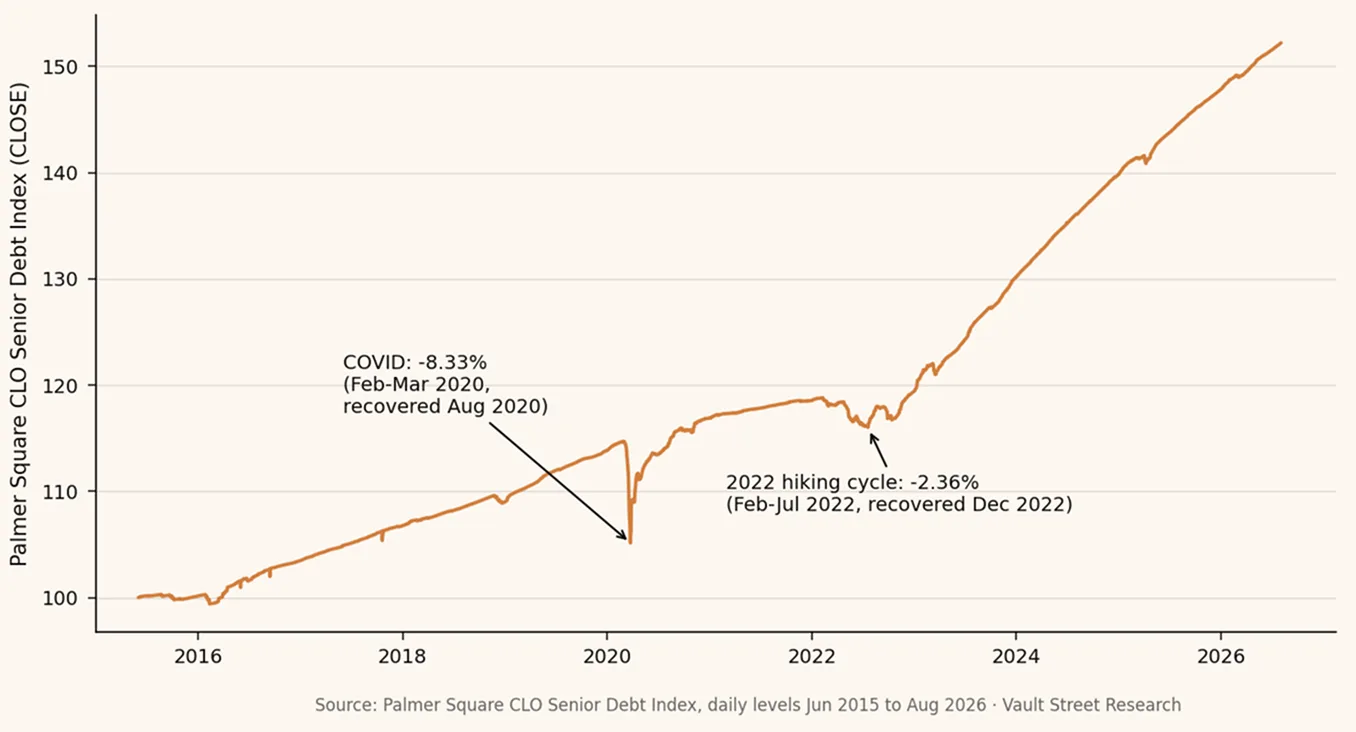
AAA CLO tranches sit at the top of the CLO capital structure: equity, mezzanine, BB, and BBB tranches absorb losses before AAA cash flows are interrupted. No AAA-rated CLO tranche has ever defaulted (per S&P Global and Moody's CLO rating performance studies).The risk that shows up in prices is mark-to-market: AAA CLO spreads widen in liquidity stress even when no credit event occurs. Computed from the ETF's full market-price history (October 2020 launch to 4 August 2026, dividend-adjusted): the worst single-day move is 1.03% down (10 April 2025), and the worst peak-to-trough drawdown is 2.6% on a total-return basis (February to July 2022 in the rate-hiking cycle, recovered by December 2022), or 4.1% on a price basis (August 2021 to November 2022).The longer-history proxy, the Palmer Square CLO Senior Debt Index (CLOSE, daily from June 2015), shows two material episodes across its history (computed from the index series): an 8.33% peak-to-trough drawdown in the COVID liquidity crisis (26 February to 24 March 2020, fully recovered by 12 August 2020, with a worst single day of 1.58% on 23 March 2020) and a 2.36% drawdown in the 2022 rate-hiking cycle (February to July 2022, recovered by December 2022), consistent with the ETF's own history over the same window. The COVID episode ran 5.5 months peak to recovery.
Rate risk
The underlying tranches are floating-rate. The ETF's effective duration has ranged 0.09 to 0.24 years across recent observations, translating a 1 bp parallel SOFR shift to roughly 0.20 bps of NAV. Income tracks policy-rate declines with a lag reflecting the tranches' reset schedules.
Diversification, correlation, and fit
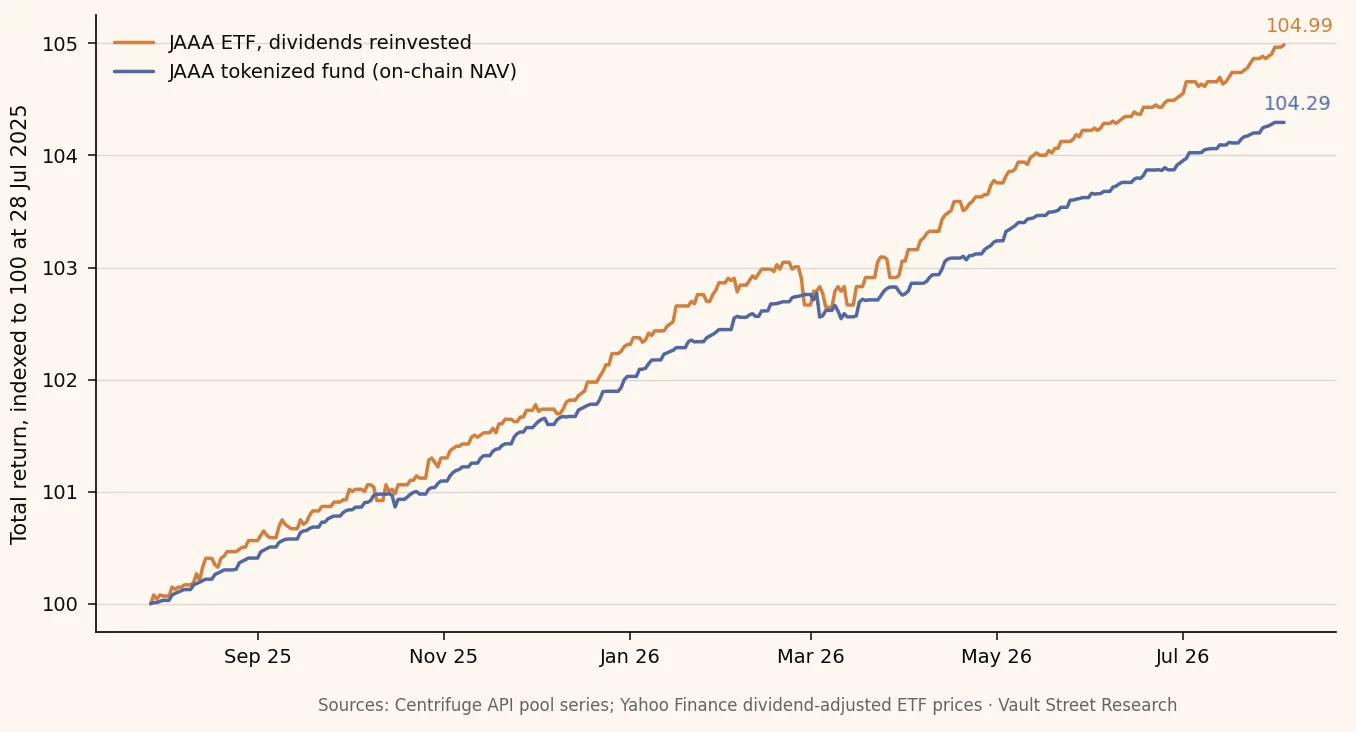
How closely does the token track the ETF? It depends on the holding period (computed against the ETF's dividend-adjusted price series over the token's life; small sample at the longest windows). Day to day there is almost no relationship (correlation near 0.1): the token's NAV moves on the administrator's recognition schedule, not on market prints. Over weeks the link stays loose (correlation 0.3 to 0.4). Over months it tightens (0.75), and over a quarter the token moves one-for-one with the ETF: correlation above 0.9 with beta near 1, minus the cost gap. In short, the token behaves like a deposit over days and like the ETF over quarters; the tracking chart below makes the same point visually. Against a Treasury sleeve such as JTRSY, JAAA adds credit spread and mark-to-market variance in exchange for SOFR-plus carry with near-zero duration.
Liquidity of the underlying
The AAA CLO market is deep: $500 to 600B outstanding across 3,000+ tranches and 135+ managers, with secondary trading reaching a record $84B in Q1 2026 (per Janus Henderson market data). MSCI Liquidity Metrics classifies 100% of the fund's assets as highly liquid, meaning the full portfolio can be liquidated within three business days. Janus Henderson executes block liquidations through banking partners at institutional pricing.
Fees & Economic Drift
| Fee | Detail |
|---|---|
| Management fee | 0.50% p.a. |
| Entry / exit fees | None |
| Performance fee | None |
| Fund-borne expenses | "Expenses paid by the Fund to third party services providers including but not limited to banks, custodians and brokers will be recharged to investors" (April 2026 Memorandum). The issuer puts the current run-rate at 6 to 7 bps of AUM (August 2026) |
Total cost in context.With the confirmed expense run-rate, JAAA's all-in stack lands around 56 to 57 bps. How does it compare to peers and wider market segment?
- The underlying ETF charges a 0.20% expense ratio but is not directly accessible to an on-chain allocator and forgoes tokenized settlement and collateral use.
- Inside the tokenized universe the direct peer is STAC (BNY / Securitize), which charges a 0.40% expense ratio with no performance fee.
- For comparison, JTRSY and USTB, tokenized t-bill MMFs under Vault Street's coverage, have on average a 30bps all-in expense ratio.
Subscription, Redemption & Liquidity
Subscription and redemption mechanics
JAAA uses Centrifuge V3 AsyncVaults (ERC-7540): both legs are asynchronous, request-based, and settled against published NAV, initiated through the Centrifuge UI, SDK, or directly against the contracts. Prospective investors complete AML/KYC with the Fund Administrator, designate a wallet, and are whitelisted; subscriptions are accepted each Business Day and may be paid in USD, USDC, or other permitted stablecoin (USDT and AUSD vaults are live on Ethereum).A redemption request takes the form of a transfer of share tokens to the fund's designated wallet, which constitutes an irrevocable request processed at NAV; proceeds are generally paid in tokenized form and may be paid in USD at the shareholder's request or where the wallet is unavailable. Investors always self-claim; the protocol cannot move funds out of an investor's wallet.
Settlement timelines
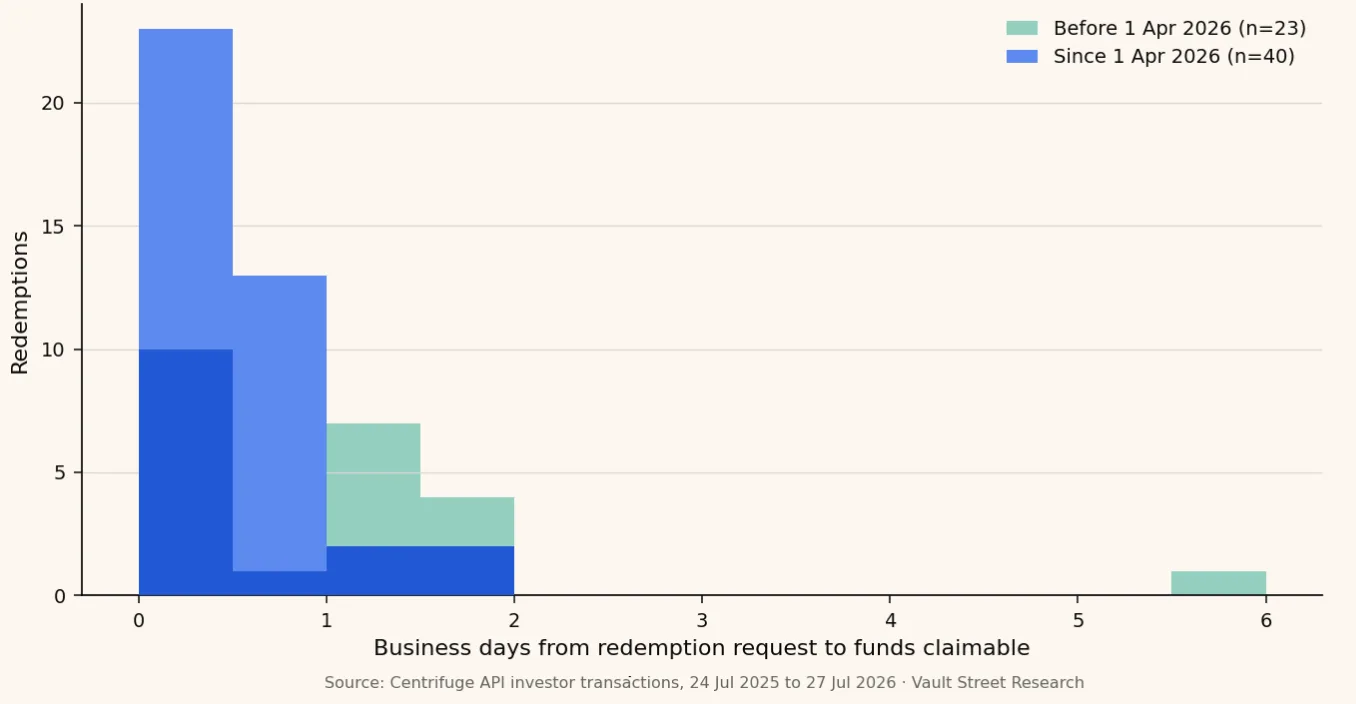
The April 2026 Portfolio Supplement specifies payment within three Business Days, with Business Days defined as BVI and US banking days: that is the contractual bound, not the operating practice. The issuer runs a same-day cycle on both legs, with requests received by 10am ET settling T+0 and requests received by 3pm ET settling T+1 (issuer confirmation, August 2026). If the tokenization infrastructure is suspended or share tokens become inaccessible, settlement falls back to an off-chain wire.Observed across the full transaction history (Centrifuge API investor transactions, 24 July 2025 to 27 July 2026, measured from first request to funds claimable): redemptions settled with a median of 0.3 business days and a P90 of 1.4 across 63 fulfilled requests. The lifetime maximum of 5.8 business days traces to a request lodged on 6 January 2026 during the fund's largest outflow window, and the slowest subscription (8.9 business days) to a 24 December request fulfilled after the holiday period. Since 1 April 2026, redemptions show a P90 of 1.0 business day and a maximum of 1.8 (n = 40) and subscriptions a P90 of 1.2 (n = 61), empirically consistent with the issuer's T+0/T+1 operating cadence.
Demonstrated exit capacity
There are no formal daily redemption limits, and no instant-redemption buffer.Cumulatively the queue has processed $665M of gross redemptions across 63 fulfilled requests since inception (through 27 July 2026, per the Centrifuge API); the anchor allocations entered as direct issuance transfers, not vault deposits, so vault-path subscription figures (about $309M) understate gross inflows. The stress precedent is 11 March 2026, when a single wallet redeemed $318.6M, 42.8% of that day's AUM, with no NAV impairment and no queue congestion; the redemption, its size, and the NAV path through it are verified on-chain.Concurrent redemption requests would be processed pro-rata if operational constraints arose, a scenario that has not occurred.
Holder base and concentration
The holder base is small and concentrated. As of 3 to 4 August 2026 (per rwa.xyz network data, the Centrifuge API, and the Grove and Ethena transparency dashboards): 33 holders across all networks and 662.5M tokens in circulation. Grove holds $391.1M, 375M tokens and 56.6% of supply, split $260.9M on Avalanche (the fund's single largest wallet, 37.7% of supply) and $130.2M on Ethereum, per its own dashboard. Ethena holds some 241M tokens (36.4% of supply) as USDe backing, split $201M on Solana and $50M on Base per its transparency dashboard, at its recommended initial allocation cap of $250M; these correspond to the 10 June and 30 July subscriptions visible in the supply ledger. Together the two anchors hold 93% of supply between them, with the remaining tokens, about $48M, spread across about 30 wallets, mostly on Ethereum.The concentration is a design feature of the fund's history: it launched in June 2025 seeded by a $1B allocation from the Sky ecosystem via Grove, and single-anchor concentration peaked near 95% of AUM during H1 2026. The AUM path traces the anchor's moves: $50M at inception to a $1,022.7M peak on 6 January 2026, down to a $396.8M trough on 31 March after two large exit waves (293.7M tokens redeemed across 6 to 20 January; the 318.6M-token block on 11 March), and back to $686.9M by 3 August, driven by Ethena's onboarding of JAAA as a USDe backing asset (approved June 2026 with a recommended initial cap of $250M, per Ethena governance, and now fully deployed).
deJAAA secondary market
deJAAA, a freely transferable ERC-20 wrapper convertible against the permissioned share token via dedicated wrap vaults, trades on Aerodrome (Base) and related venues. Secondary-market depth is trivial relative to institutional size: it supplements small transfers and cannot substitute for primary redemption.
Suspension, gating, and discretionary triggers
No queues, gates, or swing pricing are in place and no suspension has occurred. The documented Board powers are broad, including the sole-discretion catch-all, per-shareholder AML suspension, and compulsory redemption with or without cause on seven days' notice. These are the tail-risk levers an integration must underwrite: in a severe stress, on-chain redemption is not a contractual guarantee.
Smart Contracts & Technical Architecture
JAAA tokens follow the ERC-20 standard with ERC-7540 AsyncVault subscription/redemption mechanics (Ethereum USDC vault 0x4880...780b; all ten vaults tabulated below) on Centrifuge V3's hub-and-spoke architecture, the same deployment that carries JTRSY. The V3 core is immutable, with no proxy upgrade path at the contract level; protocol-level authorization and configuration changes are gated through the Root contract behind a 48-hour timelock. The deployed v3.1.0 commit (6b9d36ea) has been reviewed by four independent security reviews, with the deployment verified by Sherlock in February 2026.
Share token and vault surface
Share token addresses, per the Centrifuge deployments registry:
| Network | JAAA share token |
|---|---|
| Ethereum, Base | 0x5a0f...cf64 |
| Avalanche, Arbitrum, BNB | 0x58f9...3b6b |
| Monad, Pharos | 0xad48...f797 |
| Solana (escrow-backed, Token-2022) | AAAJXe...LLyG |
| Stellar (escrow-backed, Soroban) | CDV6U7...ZZSO |
Active subscription/redemption vaults (ERC-7540 entry points), per the deployments registry and verified against the Centrifuge indexer API (all ten vaults Active and Linked, 3 August 2026):
| Network | Asset | Vault address |
|---|---|---|
| Ethereum | USDC | 0x4880...780b |
| Ethereum | USDT | 0x4a76...0770 |
| Ethereum | AUSD | 0x3148...1106 |
| Base | USDC | 0x2AEf...Ef0b |
| Avalanche | USDC | 0x1121...7784 |
| BNB | USDC / USDT | 0x9eff...9961 / 0xcbaf...cb99 |
| Arbitrum | USDC | 0xbcde...2354 |
| Monad | USDC | 0x9260...df3a |
| Pharos | USDC | 0x499a...d6c2 |
Verified by on-chain inspection (Etherscan, 4 August 2026): the active transfer-restriction hook on the Ethereum share token is 0x3c5e...80a7, and the Root contract (48-hour timelock) holds ward rights on the token (wards query returns 1). The Ethereum share token and USDC vault addresses are additionally confirmed in live subscription and claim transactions (4 August 2026). The hook remains replaceable by a token ward via a file() call, an action that would be observable on-chain and gated behind the Root timelock; hook changes belong in ongoing monitoring.
Allowlist and transfer control
Transfer eligibility is enforced on-chain via the token's restriction hook: removal from the memberlist locks the affected tokens. The whitelist itself is governed off-chain by the Fund Administrator, and an on-chain transfer may precede its recording on the fund's books. The practical implication for a DeFi integration is that the integrating contract must itself be whitelisted before JAAA can move into or out of it.
Upgradeability and admin key control
The core protocol is immutable, so the admin surface reduces to protocol-level authorization and configuration changes, all gated through Root behind the 48-hour timelock. The table below maps the contract surface and its controls; addresses are identical across all supported networks and shared across Centrifuge V3 pools, including JTRSY and JAAA (per the Centrifuge deployments registry):
| Entity | Address (all networks) | Description | Admin key control |
|---|---|---|---|
| V3 Root | 0x7Ed4...368f | Top-level authorization contract; every protocol admin and configuration change routes through it. | 48-hour timelock on all actions; holds ward rights on the JAAA share token (verified on-chain, 4 August 2026). |
| ProtocolGuardian | 0xCEb7...35c6 | Schedules protocol upgrades and emergency pauses. | Controlled by the Guardian Safe; a separate OpsGuardian wires pools and adapters with no pause authority. |
| Guardian Safe | 0x9711...D225 | Multisig governing the ProtocolGuardian. | 4-of-9 threshold with Cantina third-party co-signers; Zodiac Delay module (24h); any single owner can pause, resumption requires the multisig. |
| Hub | 0xA4A7...1953 | Authoritative pool accounting on the Ethereum hub chain. | Immutable; under Root authority. |
| Spoke | 0xEC35...25aB | Local protocol orchestrator on each network; instantiated the share token via the token factory. | Immutable; under Root authority. |
| Balance Sheet | 0x12a1...f43e | Executes share issuance and revocation against approved request batches. | Immutable; under Root authority. |
| Share Class Manager | 0xaFFC...9BEf | Share-class configuration and NAV-per-share bookkeeping at the hub. | Immutable; under Root authority. |
| Gateway | 0x19a5...3172 | Cross-chain message entry and exit point. | Immutable; under Root authority. |
| MultiAdapter | 0x35C8...73BE | Routes cross-chain messages across the Wormhole, LayerZero, Axelar, and CCIP adapters. | Two independent adapters per route at a 2-of-2 threshold: Axelar + LayerZero for Base, Arbitrum, Avalanche, and BNB; Chainlink CCIP + LayerZero for Monad and Pharos (issuer confirmation, August 2026). Solana and Stellar sit outside the adapter system. |
| AsyncRequestManager | 0xF482...61Ae | The single contract that processes and settles all deposit and redemption batches for the JAAA vaults; the same contract serves JTRSY. It cannot reach into investor wallets (investors self-claim), but daily settlement depends on it. | Fund Manager role held by Anemoy operations. |
| Anemoy Fund Manager (Fordefi MPC) | 0x7Bf0...02eC | The operational wallet approving daily request batches through the Fund Manager role; the same address serves all Anemoy funds (issuer confirmation, August 2026). | Fordefi MPC with tiered thresholds: 2 signers to approve pending deposit or redemption requests; at least 3 signers for any other transaction; 5 admin signatures to change the Fordefi policy or to add a member. Every transaction creation notifies all signers via Slack and phone. |
Oracle design and failure modes
Chronicle Proof of Asset is the single official attestation provider, a concentration point at the publication layer whose upstream dependency is Trident's NAV calculation. Because the upstream path is self-attested, integrations are safer on a bounded downstream feed such as the LlamaGuard dynamic feed on Aave Horizon than on raw NAV.
Audit history, incidents, and bug bounty
Across its history the Centrifuge protocol reports 24 security reviews including tier-1 firms, with report PDFs published at github.com/centrifuge/protocol/tree/main/docs/audits, an operational security review with OPSEK, and zero exploits since mainnet launch in 2019 (per Centrifuge security documentation). The audit trail covers the EVM protocol: v3.1.0 was verified by Sherlock, BurraSec reviewed v3.3, and a Certora formal verification of the core contracts began on 3 August 2026 (per issuer). The Solana and Stellar issuances have not had a separate independent audit. On Solana the exposure to unaudited code is limited: no custom Centrifuge program sits in the mint path, since JAAA is a standard SPL Token-2022 mint using stock extensions, controlled through Squads, an audited and widely deployed multisig platform. Centrifuge runs an active bug bounty on Cantina with a $250,000 maximum reward.
Cross-chain messaging
Cross-chain movement between the EVM spokes relies on Centrifuge's MultiAdapter layer, and the issuer has disclosed the full configuration (August 2026): every route runs two independent adapters at a 2-of-2 threshold, so both must attest before a message executes: Axelar and LayerZero for Base, Arbitrum, Avalanche, and BNB; Chainlink CCIP and LayerZero for Monad and Pharos. The April 2026 rsETH exploit is precedent that forged cross-chain messages can drain bridged RWA positions; under dual attestation, compromising a single adapter network is not enough to forge a message. Solana and Stellar are not spokes and no adapter route reaches them: those balances rest on the escrow model described under Network Availability. Avalanche, at 250M tokens, is the largest adapter-served exposure.
Operational Dependencies & Resilience
The fund's operation depends on a chain of providers, each a potential single point of failure for a different function:
- Custodian / Prime Broker (JPMorgan Chase Bank, N.A.) — holds the CLO positions and executes trading; the integrity of the structure and the block-trade capability rest here.
- Fund Administrator (Trident Trust) — strikes NAV and operates transfer agency, whitelist, and KYC/AML; a failure here stalls pricing and therefore settlement.
- Oracle layer (Chronicle) — single official attestation provider at the publication layer.
- Stablecoin ramp (Circle / USDC) — the on-chain settlement asset; USD payment fallback available per the offering documents.
- Investment Manager ops (Anemoy) — approves settlement batches through the fund-manager role on Fordefi MPC wallet infrastructure (per the Centrifuge pool page); affiliated with the tokenization platform; the Memorandum flags key-person reliance on Messrs Quensel and Sood.
- Sub-Investment Manager (Janus Henderson) — portfolio management and block-trade execution relationships.
Resilience features: the portfolio is unlevered and classified 100% highly liquid; investors self-claim, so a protocol pause cannot strand value inside a counterparty's discretion beyond delay; the Subscription Agreement's paper-certificate fallback preserves the shareholder claim if the tokenization rail itself fails; and the issuer confirms an off-chain wire-settlement path for redemptions if share tokens become inaccessible. Issuer-side operational wallets run on Fordefi MPC, with the tiered signer thresholds set out in the governance table above.
Network Availability & Cross-Chain
The pool is anchored to Ethereum as its hub: the pool identifier (281474976710663) encodes centrifugeId 1 in its upper bits, so Ethereum carries the authoritative accounting, with share tokens issued on spoke chains and no cross-chain bridging of the share token itself; liquidity remains chain-specific by design. The share token exists on seven EVM protocol chains with ten active subscription vaults, plus native issuances on Solana and Stellar. The supply distribution as of 3 August 2026 (per rwa.xyz): of 662.5M tokens in circulation, Ethereum carries 165.6M, Avalanche 250.0M, Solana 192.9M, Base 48.2M, and Stellar 4.9M, with residual balances on BNB, Monad, and Arbitrum.Solana and Stellar work differently from the EVM spokes (issuer confirmation, August 2026). Neither is a Centrifuge protocol spoke and no adapter route reaches them. On each chain JAAA is natively issued and backed one-for-one by share tokens held in designated escrows on Ethereum: 0x5d2c...d03B holds 192,869,680 JAAA against the Solana issuance, and 0xf26E...4836 holds 4,860,312 against Stellar, matching the balances observed on those chains. No private key exists for either escrow; shares can leave only through an auth-gated protocol-level transfer. On Solana, JAAA is a Token-2022 mint (6 decimals) whose mint authority, freeze authority, and permanent delegate all sit with a Squads multisig, and accounts are frozen by default, thawed only after compliance clearance. On Stellar, JAAA is not a classic Stellar asset but a Soroban token contract, allowlist-gated, with the admin and minter roles held by a multisig. The deployments registry's omission of the native Stellar issuance is a documentation oversight the issuer is correcting.Centrifuge's deRWA wrapper deJAAA (0xaaa0...82cc on Ethereum, Base, Arbitrum, Avalanche, and BNB, plus Solana, Stellar, and Monad) is a freely transferable representation convertible via dedicated wrap vaults, a distinct instrument from the share token analyzed in this research.
Conclusion
JAAA is a credible, institutionally serviced tokenized AAA CLO vehicle and the reference product in its category. The structural integrity is sound: direct legal ownership of participating shares in a BVI segregated portfolio, custody and prime brokerage at JPMorgan Chase Bank, N.A., administration at Trident Trust, audit at MHA Cayman, a Particula AAA token rating, and the same immutable Centrifuge V3 stack that carries JTRSY, with 24 protocol security reviews and no incident history since 2019. The asset has behaved as designed: no below-par print beyond the inception strike, a worst drawdown of 0.22% recovered within three weeks, 0.46% annualized NAV volatility, and Q2 2026 carry roughly 100 bps over SOFR.Main items to watch are expense ratio and redemption timelines. The all-in cost runs meaningfully above both the underlying ETF and Treasury-sleeve peers, on a fee that has already been raised once and expenses that are recharged without a cap.As for redemptions, on the operational side there is no instant-redemption buffer: every exit runs through the primary queue, on a same-day cycle the issuer operates against a three-Business-Day contractual bound. The record supports it: nine in ten redemptions since April have cleared inside one business day.Beyond the primary rail, JAAA is live as collateral on Aave Horizon, with about $21M supplied at the time of writing, supporting leveraged carry positions against stablecoin borrowing. The market consumes the bounded LlamaGuard price feed, and the integration makes JAAA one of the few investment-grade assets with a working DeFi lending use case to date.
Disclaimer
This document is a research note prepared for informational purposes only. It is not investment, legal, tax, or accounting advice, and it is not an offer to sell or a solicitation to buy any security. Any offer is made only through the fund's offering materials to eligible investors. Figures and parameters are as of the dates indicated and are subject to change. This note draws on issuer and third-party sources that have not been independently audited, and is qualified in its entirety by the Fund Documents (the Confidential Information Memorandum, the Portfolio Supplement, and the Memorandum and Articles of Association of Anemoy Capital SPC Limited), which prevail in the event of any inconsistency. Prospective investors should review the offering memorandum and consult their own advisers.