


Our View
- Diversified, high-quality book. For this instrument specifically aimed at DeFi institutional allocations, Wellington have put together a balanced investment-grade portfolio, which spreads carry across six sectors (CLO 40%, IG corporates 25%, ABS 15%, agency MBS 10%, non-agency RMBS 5%, CMBS 5%) at an average rating of A+, with more than 75% rated A or higher.
- Quick, clean exit. Daily fair-value NAV with a T+1 operational settlement target on the standard redemption path at 0 bps; Instant redemptions are also available with a dedicated $10mn facility run by Midas at 0.50% fee. Another novel mechanic pioneered by Midas is its levered redemption pathway, allowing holders having levered positions to unwind their total amount in one day by prepositioning for the unwind operationally.
- Well-structured legal framework. Orphaned Luxembourg compartment, segregated custody, daily independent valuation, and an Ernst & Young audit; deployed contracts verified on-chain behind a 48-hour upgrade timelock.
- Watch out for. This fund offers very tight credit performance, however rates risk is not negligible. With 0.79 years effective duration, portfolio instruments can pick up sizeable revaluation in case of widening rates or shock events affecting bond market liquidity. A static model portfolio showed simulated COVID drawdown of -13.32%, which tightens over 103 days (single worst day -2.67%). This is well compensated for by a 140-160bp spread over the t-bill MMFs in benign environment.
- Overall, from our perspective it is a very sought-after instrument in the current tokenized fund market, which has so far been dominated by two extremes - ultra low risk MMFs, and high yield specialty asset-backed facilities. A balanced, investment-grade portfolio, providing a considerable yield pickup over AAA CLOs, is a unique value proposition in the current RWA universe. Vault Street has enabled allocations into mWIN from both primeUSD and (upcoming) CARRY vaults.



Vault Street powers selected vaults with mWIN
Our research and due diligence give us the confidence to use mWIN in CARRY and primeUSD vaults, delivering up to APY.
Summary
mWIN (Midas Wellington Income Opportunities, strategy name "Tokenised Income Opportunities") is a tokenized, actively managed multi-sector fixed income strategy. The issuer is Aureum Securitisation Fund, an unregulated Luxembourg securitisation fund under the Securitisation Act 2004, acting in respect of its Compartment mWIN through Aureum Manco S.à r.l. Each note carries an Authorised Denomination of USD 130,000, qualifies as a MiFID II transferable security, is unrated, unlisted, and uncleared.Wellington Management International Limited (England & Wales no. 04283513) manages the underlying portfolio under an English-law Investment Management Agreement and binding investment guidelines. Northern Trust Global Services SE (Luxembourg, RCS B232281) provides custody and daily independent valuation under a Master Custody Agreement.mWIN has been live since 29 July 2026, with ~USD 27mn printed over the first month since launch.
Key parameters at a glance
| Parameter | Value |
|---|---|
| Instrument | Up to USD 2,000,000,000 profit participating notes; direct, unsecured, pass-through, limited recourse |
| Issuer | Aureum Securitisation Fund (RCS O136), acting re Compartment mWIN, through Aureum Manco S.à r.l. (RCS B301171, 9 Rue du Laboratoire, L-1911 Luxembourg) |
| Governing law | Luxembourg; exclusive jurisdiction Luxembourg-City |
| Governing documents | T&Cs; General Management Regulations; Specific Management Regulations; IMA; Master Custody Agreement |
| Investment Manager | Wellington Management International Limited; strategy run by Wellington's Financial Reserves Management team (per IM) |
| Custodian / valuation | Northern Trust Global Services SE, Luxembourg credit institution; custody and valuation of Underlying Assets |
| Denomination / minimum | USD 130,000 per Note; on-chain divisible; minimum subscription 1 token, fractional above; minimum instant redemption 1 token |
| Regulatory | No public offering; Reg S, no U.S. Persons; UK, China, sanctioned jurisdictions restricted; MiFID II transferable securities |
| Underlying | Debt securities per the Wellington mandate, up to 100%; Internal Liquidity Sleeve up to 5% (cash, USDC/Permitted Stablecoins, tokenized U.S. T-bill exposure) |
| Model portfolio (8 Jun 2026, ex-sleeve) | Yield 5.23%; OAS 107 bps; effective duration 0.79 yrs; spread duration 2.04 yrs; DTS 254; ann. vol 2.56% (ex-ante); avg quality A+; >75% rated A or higher |
| Sector mix (model) | CLO 40% (A 35%, BBB 5%), IG corporates 25% (financials 14, industrials 9, utilities 2), ABS 15%, non-agency RMBS 5%, CMBS 5% |
| Binding mandate limits | IG weighted average rating; BBB/Baa ≤50%; below-IG ≤10%; unrated ≤10%; single structured issuer/trust ≤5% MV; effective duration 0 to 2 yrs; non-USD ≤10%, 100% FX-hedged; no leverage; derivatives permitted for risk management and pursuit of objectives; no private placements beyond 144A/Reg S/4(2) |
| Management Fee | 0.60% p.a. of Compartment NAV contractual (daily accrual Actual/365); 0.40% effective at launch via a 20 bps Midas waiver, held "until further notice" (Aug 2026) |
| Other investor-level fees | Subscription 0 bps for all investors (0.10% cap retained for future stablecoins only); instant 0.50%; standard redemption 0 bps (Repay-and-Redeem: 2% refundable deposit) |
| Tax | No withholding or structural tax leakage on payments under the Notes; Luxembourg-resident investors face added complexity |
| NAV | Fair value basis; published as soon as practicable after custodian pricing data, at latest 2 business days, on-chain; Pricing Disruption Event defers publication and redemption pricing |
| Redemption summary | Standard: 1pm Lux cutoff, same-day end-of-day NAV (published on the following day), paid within 2 BD of Underlying Asset Receipt; Instant: last published NAV, ≤2 BD, subject to sleeve/facility availability; OTC network T+4h up to $50m (IM, non-contractual) |
| Stablecoin deposits/redemptions | USDC canonical; Chainlink USDC/USD reference; Depeg Event at >2% deviation permits postponement or USD payment |
| Chain | Ethereum mainnet at launch; T&Cs pre-authorize multi-chain issuance as a single fungible series |
See what's moving before anyone else
Get our insights on RWA strategies and onchain yield, straight to your inbox.
By subscribing, you agree to receive product & research updates from Vault Street in accordance with our Privacy Policy. You can unsubscribe at any time.
Fund Structure & Legal Framework
Legal entity and compartment structure
Aureum is an unregulated securitisation fund without legal personality, acting through Aureum Manco S.à r.l. The Compartment mWIN receives all assets, rights, claims, and agreements relating to the Notes. Limited recourse and non-petition are both statutory and contractual: investors have recourse only to Compartment assets remaining after satisfaction in full of Unitholder claims; claims extinguish once Compartment assets are realised; investors waive attachment and any winding-up petition; these provisions survive redemption, and Clause 9 of the Subscription Agreement prevails over any conflicting provision. The Issuer may under no circumstances be replaced as principal debtor.The orphaning chain: the Midas Purpose Trust, administered by Hawksford (Hawksford Trust Company Jersey Ltd as settlor, Hawksford Trustees Jersey Ltd as trustee, Hawksford Fiduciaries Jersey Ltd as enforcer), holds 100% of the ManCo's shares and the fund units issued by the SF and its compartments. Aureum Manco makes management decisions for the fund and compartments; Ernst & Young Luxembourg appointed as an auditor.
The Units
Luxembourg securitisation compartments must have a unitholder, so the Compartment issued 2 Units of USD 1 each, held by the Purpose Trust trustee and not acquirable outside the structure. The Notes rank behind them, but their entire entitlement is USD 2 of principal plus a symbolic USD 42 paid on redemptions, with no participation in portfolio returns: keeping the Units economically empty is what preserves the orphan structure.
Regulatory positioning
The notes are offered without public offering or listing, outside the Securities Act under Reg S, with no Luxembourg or foreign authority approval, and constitute transferable securities under MiFID II. Platform-level eligibility excludes U.S. Persons and restricts the UK, China, and sanctioned jurisdictions (per Midas eligibility documentation).
Nature of the token and the asset chain
The token is the note: a ledger-based registered security whose Register is the blockchain. Investors have no direct right to the Underlying Assets (Condition 8.1); exposure is a pass-through profit participation. Annex 2 confirms the Compartment holds the debt securities directly through the Wellington mandate: there is a management mandate at the compartment, custodied at Northern Trust.One clause is built for DeFi: where notes sit in a smart contract, expressly including collateralised lending arrangements, the greenlisted depositor with the contractual withdrawal right is the beneficial owner for the purposes of exercising rights, including redemption (Condition 2.2(e)).
Service-provider architecture and independence
| Entity | Role | Independence / detail |
|---|---|---|
| Aureum Manco S.à r.l. | Management company; receives the Management Fee; bears Operational Costs | Orphaned via Midas Purpose Trust: sole shareholder is the trustee, with ad nutum power over the board. Incorporated 20 Oct 2025; object limited to securitisation-fund ManCo, unlicensed by design; A/B board (every resolution needs an A-manager, joint A+B signature). |
| Hawksford (three Jersey entities) | Settlor, trustee, enforcer of the Purpose Trust | Independent fiduciary (JFSC 15636); apex of the orphan structure: sole shareholder of the ManCo with at any time, without cause dismissal power and holder of both Units (USD 2). Liability capped to trust assets. |
| Wellington Management International Ltd | Investment Manager under English-law IMA | Fully independent; replaceable by the Issuer |
| Northern Trust Global Services SE | Custodian and valuation agent | Fully independent; Luxembourg credit institution. Assets held in a designated client account in the name of the Compartment, segregated from Northern Trust's proprietary assets; neither Northern Trust nor any sub-custodian holds rehypothecation, use, or reuse rights |
| Midas | Sponsor, platform and interface, oracle operator, MSL operator | Principal; concentrated affiliated roles |
| Luxembourg Auditor | Fund audit | Ernst & Young Luxembourg |
| Keyrock, InfiniFi, Fasanara Capital, Midas, Symbiotic RFO | OTC liquidator network (per IM) | Mixed |
| Chainlink, vLayer, LlamaRisk | FX reference, NAV notarization, PoR design | Independent infrastructure |
Bankruptcy remoteness and insolvency protection
Protection runs through three layers.
- Statutory segregation: the Compartment is a separate estate, with limited recourse, non-attachment, and non-petition undertakings that survive redemption.
- Orphaning: the Purpose Trust holds both the ManCo's shares and the Units, so no Midas party owns or controls the issuance stack, and the trustee can dismiss and replace ManCo managers at any time, without cause.
- Independent custody: assets sit at Northern Trust in a segregated account in the Compartment's name, with no rehypothecation rights (issuer confirmation, Aug 2026). A manager or custodian failure does not impair the assets; both are replaceable by the Issuer. Official notice period is not defined in the T&Cs.
Investment Mandate & Portfolio
Mandate and eligibility constraints
The Income Opportunities Portfolio aims to generate attractive total return and realized income while preserving capital and limiting realized losses; the mandate runs unbenchmarked. Eligible instruments: senior secured and unsecured debt, subordinated debt, REIT corporate debt, inflation-linked securities, loan participation notes, repo and reverse repo, and the full securitized stack (agency MBS, CRT (CAS/STACR), non-agency MBS/CMBS/ABS, TBAs, covered bonds, CMOs including IO/PO and inverse floaters, CLOs); 144A and Reg S permitted; no private placements beyond 144A/Reg S/Section 4(2). Binding limits: IG weighted average rating; BBB/Baa capped at 50%; below-IG capped at 10%; unrated capped at 10% (middle of three agency ratings, lower of two, WMC-equivalent for unrated); single structured issuer or issuing trust capped at 5% of MV (governments exempt); portfolio effective duration 0 to 2 years, no per-security limit; USD-denominated, non-USD securities capped at 10% and 100% FX-hedged (99 to 101% band); no leverage (overdrawn on a settlement basis constitutes leverage); derivatives permitted (rate, credit, index futures; IRS, TRS, CDS; bond and swap options; TBAs) for risk management and in pursuit of the objectives. Limits are measured at time of purchase; passive breaches require client notification within 30 days and consultation; expected ratings may be used for new issues.
Live portfolio and NAV since launch
30 days
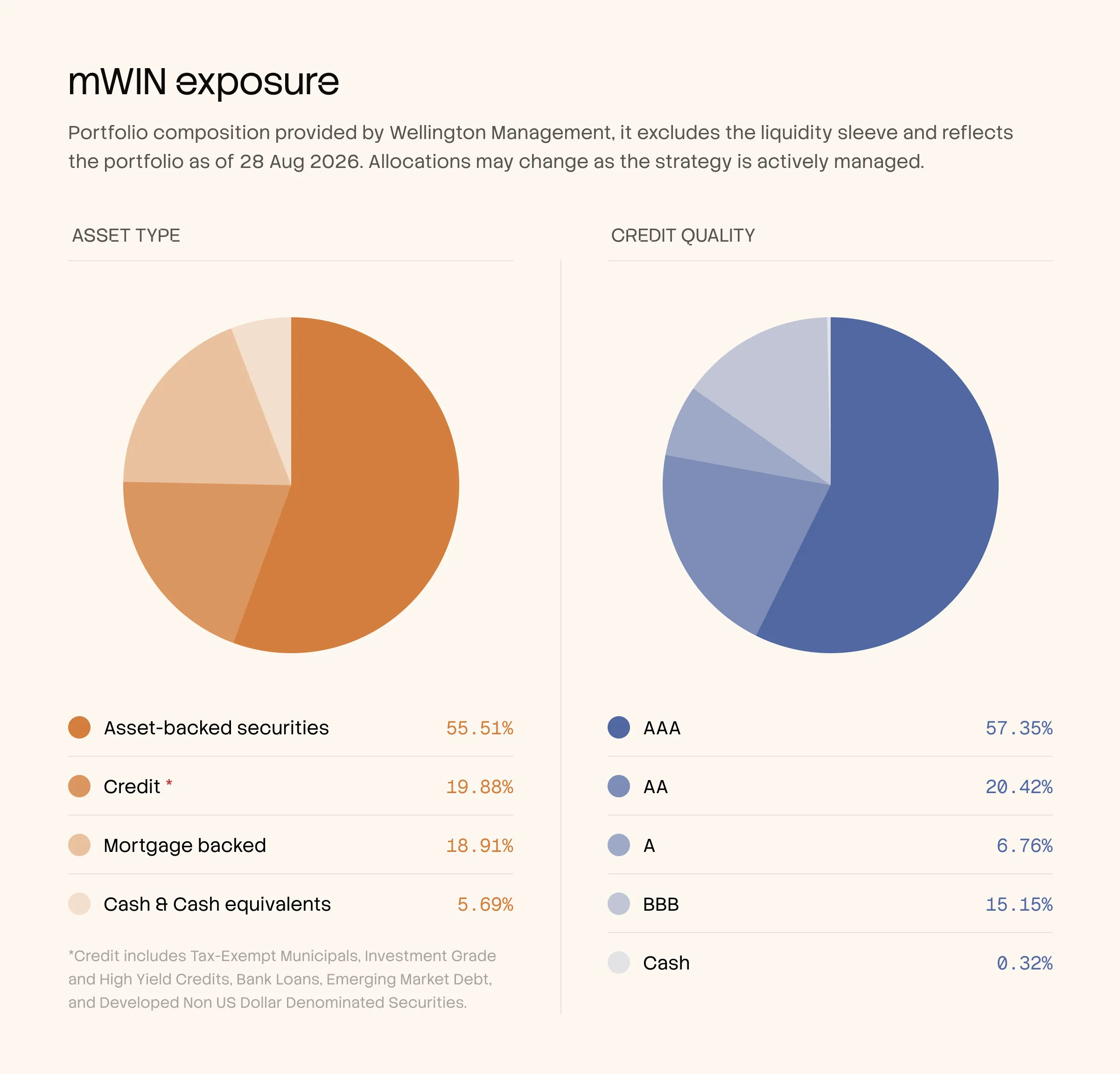
The live exposure (Wellington-provided snapshot on the transparency page, 28 August 2026, excluding the liquidity sleeve) puts the book at 55.51% asset-backed securities, 19.88% credit, 18.91% mortgage-backed, and 5.69% cash and equivalents. By rating, the portfolio sits high in the capital structure, with AAA-AA rated securities taking almost 80% of the portfolio. Allocations reflect active management and dated snapshots, and will change as the strategy is managed.
Manager risk infrastructure and oversight
Wellington's risk stack is institutional and documented: proprietary enterprise risk system, provides mandate-specific market-risk reporting and firmwide consolidation; the Portfolio Management Tool (PMT) gives real-time exposure views (MV%, CTD, CTSD), pre-trade what-if analysis, and a compliance engine holding each client's guidelines for immediate pre-trade testing; LiEF (Wellington's Liquidity Evaluation Framework) simulates portfolio liquidation timelines and costs, including urgency-cost tradeoffs; Bloomberg PORT and Yield Book supplement. Oversight layers: the lead PM is accountable, with the GPS group (Investment Risk & Performance Strategy) monitoring market risk independently, Product Management investment directors reviewing consistency, and the Investment Risk Review Group reporting into the Investment Risk Oversight Governance Committee and the Executive Committee; management teams formally review each portfolio team roughly every 18 months.
Liquidity of the underlying
Wellington's LiEF simulation for the mWIN model portfolio (7 July 2026; 82 positions, ~USD 100m market value) quantifies the liquidation profile. In current market conditions, 99% of the book liquidates within 1 week and 100% within 1 month; the expected path clears roughly two thirds of the portfolio on day one and completes within 6 to 8 days, with the conservative (low) path completing in about two weeks. Total transaction cost is 0.24% for an orderly liquidation and 0.71% for an immediate fire sale of the entire book, with the fire-sale premium decaying to near zero by approximately day five.Under LiEF's stressed conditions, approximately 68% of the book liquidates within 1 week and ~98% within 1 month, with expected transaction cost of roughly 120 bps and up to ~295 bps in a stressed fire sale. At sector level, Treasuries and agency passthroughs carry 2 to 5 bps of transaction cost in both scenarios, while CMOs (0.63% normal, 1.88% fire sale) and the structured credit bucket account for most of the liquidation cost. Wellington notes the intervals are simulated on historical market conditions and actual liquidation results may differ.Against the redemption terms: the base-case profile is consistent with the T+1 operational settlement target, while the stressed case, in which roughly one third of the book requires more than a week to liquidate, is the scenario the pass-through payment drafting (settlement on Underlying Asset Receipt) is designed for. Until the holdback mechanism is implemented (targeted Q4 2026), a stressed instant redemption executes at the last published NAV while realized liquidation costs of 120 to 295 bps are borne by the NAV of remaining holders.
Fees & Economic Drift
| Fee | Detail (per T&Cs unless noted) |
|---|---|
| Management Fee | 0.60% p.a. of Compartment NAV contractual, accrued daily (Actual/365), paid quarterly to the ManCo in consideration for the ManCo bearing Operational Costs (audit, legal, notarial, corporate services, registration, publication, accounts and wallets). 0.40% effective at launch via a 20 bps Midas waiver, "until further notice"; waiver discretionary and revocable (Aug 2026) |
| Operational cost overflow | Costs not covered by, or exceeding, the Management Fee are paid by the Compartment in the Priority of Payments; no history of overflow at other Aureum compartments |
| Subscription fee | 0 bps for all investors; the 0.10% cap is retained only against future stablecoins with expensive off-ramping |
| Instant redemption fee | 0.50% |
| Holdback | proposed structure ~5 to 10% withheld over the standard redemption period, go-live targeted Q4 2026; until live, instant redemptions execute at last published NAV |
| Standard redemption | fee-free |
| Sleeve drag | Target 5%, composition T-bills; sleeve yield accrues to NAV |
| Net carry estimate | ≈4.75 to 4.8% p.a. at the launch fee waiver (blended gross ≈5.17% less 40 bps); ≈4.55 to 4.6% at the contractual 0.60%; before transaction and facility costs and any operational overflow |
Subscription, Redemption & Liquidity
Subscription mechanics
KYC/AML completion and greenlisting are conditions precedent; subscription requests specify amount and wallet; payment in USDC/Permitted Stablecoins at the Chainlink exchange rate.Notes are issued at the NAV-based Issue Price and credited atomically. The subscription agreement auto-terminates if no closing occurs within 60 days.
Redemption pathways
| Path | Pricing | Payment | Availability / conditions | Fee |
|---|---|---|---|---|
| Instant | Last published NAV at request | Atomic | Subject to Internal Liquidity Sleeve and/or External Liquidity Facility; Issuer may reject, defer, or partially process | 0.50% |
| Standard (Normal) | Same-day end-of-day NAV (published on the following day); 1pm Luxembourg cutoff, later requests roll | Within 2 BD of the Issuer receiving Underlying Asset Receipt | Unconditional in amount (100% of NAV), pass-through in timing | 0 |
| Standard (Repay-and-Redeem) | As Standard | As Standard | Timeframe equals the standard redemption timeline; 2% security deposit, returned within the standard timeframe | 0 |
Issuer expectation: standard redemptions are processed within 1 to 2 business days in practice; the Underlying Asset Receipt condition is characterized as market-disruption protection, not a basis for indefinite delay, with the Compartment's liability fixed at the NAV lock. No contractual long-stop.At launch the live paths are instant (50 bps), standard, and Repay-and-Redeem; the holdback mechanism is announced but not yet implemented.
Repay-and-Redeem mechanism (looped positions)
A documented unwind route for mWIN used as lending-venue collateral, contractually grounded in the T&Cs: the investor requests the unwind, posts a deposit of up to 2% of the redemption value, Midas reserves the redemption liquidity, and the position unwinds iteratively (redeem to USDC, repay debt, release collateral, repeat) at zero redemption fees, settling per cycle on standard-redemption timelines. Completing within the agreed timeframe returns the deposit; liquidation, abandonment, or timeout lets Midas release the reserved liquidity and apply the deposit against the cash drag incurred.
Instant liquidity facilities and seniority
The Internal Liquidity Sleeve (up to 5%: cash, USDC/Permitted Stablecoins, tokenized T-bill exposure) is the first layer; the $10m MSL line sits on top, dedicated to mWIN and scaling with TVL under a platform policy of 10% of TVL for instant liquidity across Midas products. Contractually, facility borrowings are Compartment liabilities ranking ahead of the Notes in the Costs waterfall, and instant redemptions remain conditional on availability, with explicit reject, defer, and partial-processing powers.On an instant redemption, USDC is paid from the sleeve or the MSL pool net of the fee, tokens are burned, and the facility is repaid within 2 business days from asset liquidation. The holdback mechanism protecting remaining holders from stale-price redemptions is targeted for Q4 2026, with a proposed structure of ~5 to 10% withheld over the standard redemption period; until it is live, instant redemptions execute in full at the last published NAV.
Suspension, gating, and discretionary triggers
Midas may halt deposit and redemption processing when market conditions cast uncertainty on the validity of the latest price, expected hours to days (per Midas platform documentation). Note-terms level: pass-through payment contingency, Pricing Disruption deferral, Depeg postponement, and the availability condition on instant paths collectively perform the gating function; there is no separate suspension clause.
Stablecoin rails
USDC is canonical with the Chainlink USDC/USD feed as the Exchange Rate. It is worth noting that in case of a depeg event (>2% deviation of USDC), the Issuer is permitted to postpone until re-peg, or make a USD payment, at the Issuer's discretion with 2 BD notice.
Smart Contracts & Technical Architecture
Contract surface (Ethereum Mainnet)
Addresses provided by the Midas team and independently verified against the mainnet section of the official repository; all six are TransparentUpgradeableProxy instances in the repository's OpenZeppelin manifest.
| Contract | Address | Notes |
|---|---|---|
| mWIN token | 0x4E72...B67A | "Midas Wellington Income Opportunities"; permissioned mToken, greenlist-gated transfers |
| Custom aggregator (mWIN/USD) | 0x1725...9517 | 0.27% max per-update deviation; oracle-manager gated |
| Data feed | 0xa27c...4077 | Chainlink-compatible read surface for the vaults |
| Deposit vault | 0xF7F1...7db4 | 0 bps instant fee; sanctions screening; 0.2% variation tolerance |
| Redemption vault (swapper) | 0x6057...7924 | falls back by swapping into mTBILL and redeeming via mTBILL's USTB vault (0x569D...f0Ec), internal fees waived |
| Redemption vault (mToken) | 0x14fE...9fca | Redeems mWIN into mTBILL |
Allowlist and transfer control
mWIN enforces its allowlist at the token level: _beforeTokenTransfer requires the transferring parties to hold the mWIN-specific greenlist role (M_WIN_GREENLISTED_ROLE), so mWIN can only move between wallets and smart contracts whitelisted by Midas, with no enable/disable toggle at that layer. Transfer additionally requires the sending user to hold at least 1 mWIN in balance. The vaults' separate greenlist toggle (greenlistEnabled() = false on-chain) governs the platform-general GREENLISTED_ROLE and is off for mWIN because the token-level check supersedes it.
Upgradeability and admin key control
All six mWIN contracts are TransparentUpgradeableProxy instances under a single platform-wide ProxyAdmin, owned by the mainnet MidasTimelockController with a 48-hour minimum delay. Operational roles (greenlist, pauser, minter/burner, feed admin, vault admin) sit on the shared MidasAccessControl registry under M_WIN-prefixed roles. Management vaults are dedicated per product, so the token, feed, and vault-manager keys are specific to mWIN; the deposit-vault and redemption-vault admin roles are the exception, shared across the Midas product range (issuer, Aug 2026). Two consequences follow: the administrative surface is largely product-segregated, with the dv/rv admins as a shared residual, and everything below the upgrade layer (fees, limits, pauses, greenlisting, price submission) executes without timelock delay. Signers operate on ForDefi MPC infrastructure. Addresses verified against the midas-apps/contracts repository (mainnet deployment configuration and OpenZeppelin manifest).On-chain state independently verified 17 August 2026 via public RPC (Ethereum mainnet only). Confirmed: ProxyAdmin owned by the timelock, all six proxy admin slots, 48-hour minimum delay, production fees, oracle parameters, role assignments.
| Role / function | Address | Powers | Timelocked | Signatures required |
|---|---|---|---|---|
| ProxyAdmin (platform) | 0xbf25...0AaC | Upgrades the implementation of all six mWIN proxies | Yes, 48h minimum delay | 4 |
| MidasTimelockController (mainnet) | 0xE3EE...1852 | Executes ProxyAdmin actions after the delay | Yes, 48h minimum delay | 4 |
| Timelock proposer | 0xB608...7E89 | Schedules, executes, and cancels timelocked actions (PROPOSER + EXECUTOR + CANCELLER) | No | 1 of 3 (Gnosis Safe v1.4.1): one Fireblocks MPC and one ForDefi MPC (4 internal approvers each) and one Safe (3/7) |
| MidasAccessControl (role registry) | 0x0312...aC4B | Holds all M_WIN role assignments (greenlist, pauser, minter/burner, feed admin, vault admin) | No | DEFAULT_ADMIN held by exactly two addresses, verified on-chain: the 1-of-3 proposer Safe (0xB608...7E89) and a ForDefi access-control admin (0xd419...1227). Role changes execute without timelock delay; the registry contract itself is upgradeable only through the 48h timelock. Approver quorums are custodial policy inside ForDefi: manager operations at 4-of-N, and greenlist grants at 2 approvers via a ForDefi transaction policy on the access-control admin, scoped by ABI to grantRole calls for M_WIN_GREENLISTED_ROLE only, with any change to the policies themselves requiring 4 approvers (issuer, Aug 2026). |
| Token manager | 0x20D4...5125 | Token-level roles: mint/burn authority, greenlist administration, pause | No | 4 |
| Vaults manager | 0x2ACB...9A12 | Vault administration: fees, instant daily limits, payment tokens, function-level pause on deposit and redemption vaults | No | 4, except pausing instant mint/redeem allowed at lower threshold for emergencies; unpausing requires 4 |
| Oracle manager | 0x532F...92d3 | Feed administration: daily price submission | No | 3 (incl. Blockaid) for updates within onchain safeguards; 4 for updates bypassing onchain safeguards |
| Request redeemer | 0xF812...2737 | Processes standard redemption requests | No | 4 |
Fordefi team representative confirmed that the Midas team manages the following EOA addresses through Fordefi: 0xd419...1227 0x532F...92d3; the X-of-N thresholds are internal MPC policy, not observable on-chain.
Oracle design and failure modes
Daily role-gated submission bounded by the 0.27% deviation cap and min/max bounds, with the vaults' 0.2% variation tolerance as a second guard between feed and executable prices.
Audit history, incidents, and bug bounty
Platform stack: private review (Côme du Crest), contest-based public audits on Sherlock; $1,000,000 dual-platform bounty with Sherlock and Cantina, up to $500,000 for criticals.mWIN's deployment has been independently verified by Côme du Crest in two audits (Deployment Audit, 2026-06-25; Update Audit, 2026-08-21): deployed bytecode for the mWIN token, custom aggregator feed, and redemption vaults exactly matches source at identified repo commits, with contract state, proxy admin/timelock structure, and role assignments verified on-chain.
Operational Dependencies
Dependency map
The product's daily operation runs through a chain of providers, each a potential single point of failure for a different function.
| Dependency | Function | Failure mode and consequence |
|---|---|---|
| Northern Trust Global Services SE | Custody of the Underlying Assets; daily independent valuation feeding the NAV and the transparency page | A custodian outage is an enumerated Pricing Disruption Event: NAV publication, redemption pricing, and settlement defer until resolved. Custody of assets itself is insulated by segregation |
| Wellington Management International | Portfolio management; internal valuation cross-check before oracle publication; exposure snapshot for the transparency page (weekly target; issuer, Sep 2026) | Manager failure does not impair assets (compartment ownership, Northern Trust custody); the Issuer may appoint a successor |
| Midas | Oracle operation, vault and role administration, MSL, subscription interface, transparency page, sponsor functions | The operational center of the stack. A Midas failure halts primary issuance and instant redemption processing via the web interface (backup routes remain open); the orphan structure protects the assets |
| Aureum Manco S.à r.l. | Luxembourg management decisions; regulated administration and structure certification | Administrative stall; ManCo is orphaned and its failure is insulated from the compartment estate |
| Hawksford (three Jersey entities) | Settlor, trustee, enforcer of the Midas Purpose Trust | Trust-layer disruption; professional fiduciary with standard succession practice |
| Chainlink | USDC/USD Exchange Rate reference for stablecoin payments and Depeg determination | T&Cs provide a fallback: the Issuer determines the rate from other reputable price sources |
| vLayer and the CRE workflow | Notarization of custodian NAV data; daily Proof of Reserve attestation (99.5%+ target) | Degradation affects transparency and verifiability, not settlement; NAV publication does not legally depend on the attestation layer |
| USDC / Circle rails | Canonical subscription and settlement asset | Peg or convertibility stress; the Depeg regime (>2% deviation) allocates the tail: the Issuer may postpone payment or pay USD at its discretion |
Network Availability & Cross-Chain
Ethereum is the canonical accounting chain and sole subscription and redemption venue. The T&Cs pre-authorize multiple Supported Blockchains with notes forming a single fungible series and cross-chain transfers preserving status, ranking, and fungibility.
Conclusion
mWIN pairs an institutional asset-management stack with a Luxembourg orphan securitisation wrapper: Wellington runs the mandate under binding guidelines, Northern Trust provides segregated custody and daily independent valuation, Ernst & Young audits, and the Purpose Trust structure keeps the issuance stack outside any Midas party's ownership, with limited recourse, non-petition, and compartment segregation resting on statute as well as contract. The diligence verified the on-chain deployment against source at identified repository commits, confirmed the 48-hour timelocked upgrade path and role architecture via public RPC, and reconciled the redemption terms against Wellington's LiEF liquidation profile.The economics are credit carry: roughly 4.75 to 4.8% net at the launch fee waiver, from a spread-long, rates-flat book whose spread duration (2.04 yrs) is roughly 2.6 times its rate duration, and whose stressed behavior is better proxied by the simulated COVID episode (-13.32% over 103 days, with the single worst day at -2.67%) than by NAV stability since launch. Live exposure to date runs higher-rated than the model (AAA 57.35% on 28 August against 5% modeled), so the current book is more conservative, and likely lower-carry, than the strategy's target shape. Investors are compensated for bearing mark-to-market spread risk, pass-through settlement timing in disrupted markets, and, until the holdback mechanism ships, the socialization of stressed liquidation costs across remaining holders. Two features of the design deserve equal weight in that assessment: the binding guidelines permit materially more credit risk than the launch model shows (BBB to 50%, below investment grade to 10%, limits tested at purchase only), so the A+ profile reflects manager positioning rather than a mandate floor; and while the assets sit behind independent custody and a timelocked upgrade path, day-to-day operation concentrates in Midas across the oracle, vaults, liquidity facility, and interface, with operational roles executing without timelock delay.
Disclaimer
This document is a research note prepared for informational purposes only. It is not investment, legal, tax, or accounting advice, and it is not an offer to sell or a solicitation to buy any security. Any offer is made only through the fund's offering materials to eligible investors. Figures and parameters are as of the dates indicated and are subject to change. This note draws on issuer and third-party sources that have not been independently audited, and is qualified in its entirety by the fund's governing and offering documents, which prevail in the event of any inconsistency. Prospective investors should review the offering materials and consult their own advisers.