



Our View
- USCC is the most renowned tokenised crypto basis fund with $180M in assets as of 30 October 2026. USCC, created by Superstate in 2024, and now managed by Bitwise, executes a rolling strategy of crypto majors, such as BTC, ETH, XRP, and SOL, hedged with term futures on CME and CFTC-regulated exchanges.
- We love the robust approach to liquidity, which makes this instrument a close contender to a cash-plus instrument. As an example, the largest single-day redemption to date was $100M, settled T+1.
- Best fit is a carry sleeve or collateral asset for allocators who want crypto funding-rate yield without price exposure: realised volatility of 1.2%, a worst 1-day drawdown of 0.48%. The fund is accepted as collateral on Aave Horizon, Kamino, and Morpho markets (via 3F), which makes it one of the most composable RWAs in the space.
- Things to watch out for include the cyclicality of returns. Carry on digital asset basis trade ranges between zero and high single digits, and in bear or sideways markets USCC keeps a significant part of its allocation in t-bills.
- Vault Street has approved USCC for its CARRY and primeUSD allocations.


Vault Street powers CARRY with USCC
Our research and due diligence give us the confidence to use USCC in CARRY, delivering APY.
Summary
USCC is the tokenised share of the Bitwise Crypto Carry Fund, a series of Superstate Asset Trust, a Delaware statutory trust. The fund runs a crypto cash-and-carry book: long spot BTC, ETH, SOL and XRP, short the listed futures against them on CME and Coinbase Derivatives, with part of the SOL staked for additional yield and the balance in cash margin and the tokenised Treasury fund USTB. Bitwise Investment Manager, LLC became manager on 1 June 2026, replacing Superstate Inc.; the token, the contracts and the service providers did not change. Shares are held as tokens on Ethereum, Plume and Solana, or as book-entry records with the transfer agent.Two things distinguish the product in its category. First, venue quality: the hedge is cleared through CFTC-registered futures commission merchants with customer margin segregated under CFTC rules, and the spot and staked assets sit with Anchorage Digital Bank, a federally chartered custodian. Second, depth of DeFi integration: as a highlight, about 17% of shares sit in Aave Horizon as collateral.For an allocator, the main point to consider is cycle-dependent volatility of yield. In 2025, average yield was 8.98%, while in 2026 YTD, it runs at 4.3% as crypto funding rates fell during 1H.
Key parameters at a glance
| Parameter | Value |
|---|---|
| Legal form | Series of Superstate Asset Trust, a Delaware statutory trust organised in series (per superstate.com and SEC Form D) |
| Inception | 12 July 2024 at $10.00 per share, as Superstate Crypto Carry Fund; renamed on the June 2026 change of manager |
| Regulatory status | Private placement under Section 4(a)(2) and Rule 506(c); excluded from the Investment Company Act under Section 3(c)(7); manager registered with the SEC as an investment adviser and with the CFTC as a commodity pool operator and commodity trading adviser (Rule 4.13(a)(3)) |
| Eligible investors | Accredited investors who are also Qualified Purchasers; minimum $100,000 |
| Investment Manager | Bitwise Investment Manager, LLC |
| Transfer agent and tokenisation | Superstate Services LLC (SEC-registered transfer agent) |
| Custodian | Anchorage Digital Bank N.A. |
| Futures brokers | CFTC-registered futures commission merchants clearing the CME and Coinbase Derivatives positions |
| NAV agent | NAV Consulting, Inc. (NAV Fund Services) |
| Auditor | Ernst & Young LLP |
| Underlying | Spot digital assets (today BTC, ETH, SOL, XRP), short futures against them, staked SOL, USD margin and USTB |
| Fees | 0.75% management fee on average daily NAV; no performance fee; 0.95% expense ratio including 0.20% of other expenses (Bitwise fact sheet, 30 September 2026) |
| Blockchains | Book-entry 45.6% of shares, Ethereum 39.7%, Plume 11.6%, Solana 3.1% (superstate.com, 1 November 2026) |
| On-chain mint and redeem | No atomic on-chain mint or redeem. Subscriptions can be funded by USDC transfer on chain, with shares minted once the cash has settled; redemptions are requested by sending shares to the token contract or calling its burn function, with payout off chain in USD or USDC |
| Dealing | Each Market Day. Orders by 5pm ET priced at that day's NAV. Payout T+1 for requests before 5pm ET, T+2 after (per Superstate docs) |
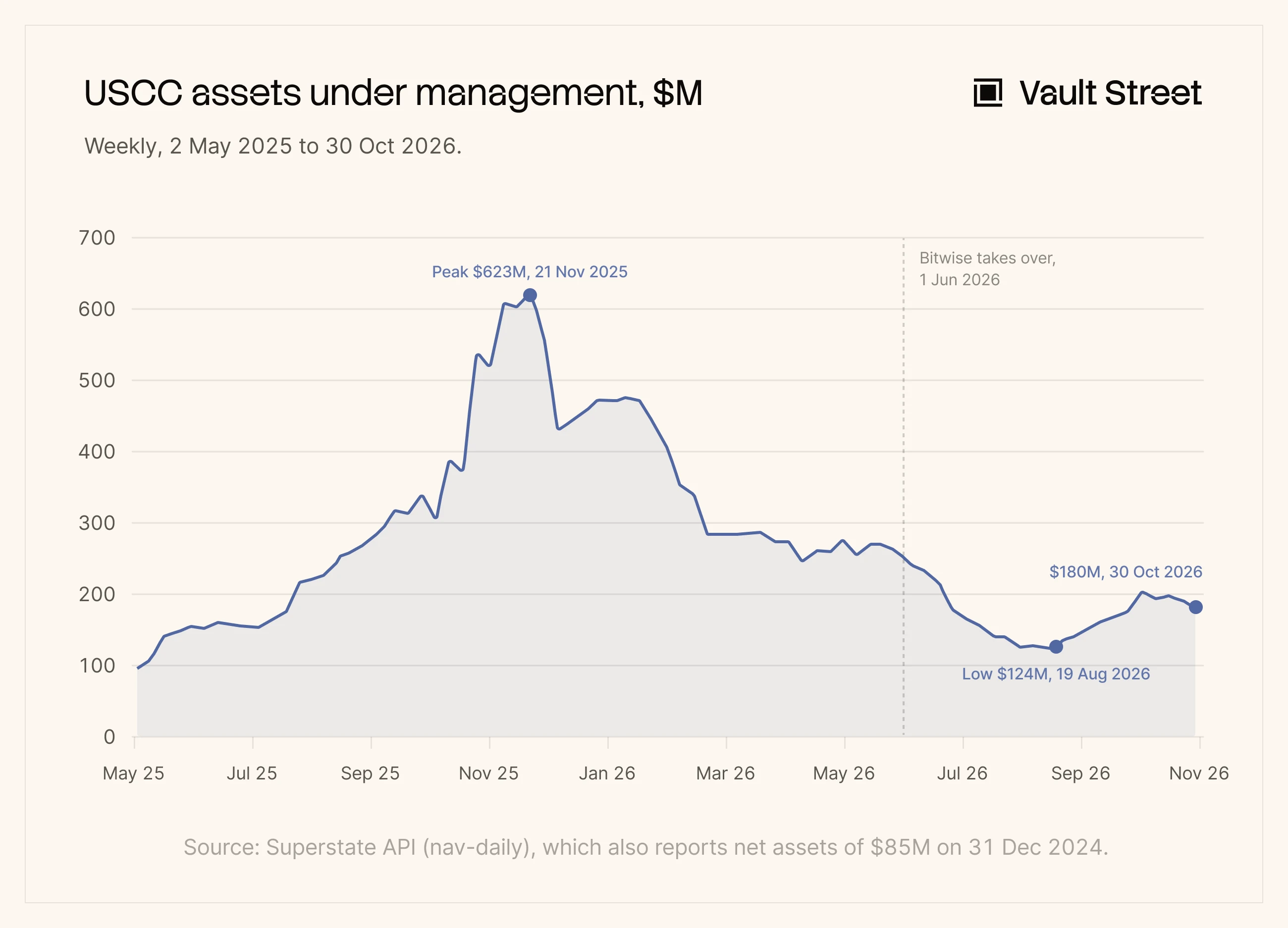
| AUM | $179.6M on 30 October 2026 (Superstate API); peak $623M on 21 November 2025, low $124M on 19 August 2026 |
| Track record | NAV $10.00 to $11.82, +18.2% since inception (7.54% annualised); 8.98% in calendar 2025; 4.31% over the twelve months to 30 October 2026 |
See what's moving before anyone else
Get our insights on RWA strategies and onchain yield, straight to your inbox.
By subscribing, you agree to receive product & research updates from Vault Street in accordance with our Privacy Policy. You can unsubscribe at any time.
Fund Structure & Legal Framework
Legal entity and series structure
Superstate Asset Trust is a single Delaware statutory trust that holds several funds, each in its own series. USCC is one series; USTB is another. The rules for the trust and for each series are in the Trust Agreement and the other Fund Documents, which investors can read in the Superstate investor portal.Three parties run the structure. Superstate Services LLC administers the trust. CSC Delaware Trust Company is the trustee, a formal role required under Delaware law. Each series has its own investment manager: Invesco for USTB, Bitwise for USCC.The assets of USCC belong to the USCC series, not to the trust as a whole (per Superstate's legal-structure page). Delaware law keeps the assets and liabilities of each series separate from the others, provided the trust records that separation in its certificate of trust. In practice this means that creditors of another series could not reach USCC's assets. We are not aware of any court decision testing this separation or of a bankruptcy court dealing with a failed series, so holders rely on the statute as written rather than on precedent.
Regulatory positioning
The fund is sold privately. It relies on Section 4(a)(2) and Rule 506(c) of the Securities Act, which permit a private sale to verified accredited investors, and on Section 3(c)(7) of the Investment Company Act, which keeps the fund outside that Act provided every investor is a Qualified Purchaser. The fund therefore carries none of the protections of an SEC-registered fund; the investor is assumed to be sophisticated.The manager, Bitwise Investment Manager, is registered with the SEC as an investment adviser and with the CFTC as a commodity pool operator and commodity trading adviser, because the fund trades futures. It relies on CFTC Rule 4.13(a)(3), which reduces the reporting owed to the CFTC for a pool sold only to sophisticated investors.Investor onboarding, including compliance checks, anti-money-laundering screening and accreditation review, runs through Superstate's investor portal.
Nature of the token
A USCC token is a share of the fund: ownership is recorded either as a token or in book-entry form. There is no wrapper, feeder or SPV between the holder and the fund. The transfer agent's register is authoritative and reconciles book-entry holdings with the three chain supplies.
Service-provider architecture and independence
| Entity | Role | Independence |
|---|---|---|
| Bitwise Investment Manager, LLC | Series Investment Manager | Principal. SEC and CFTC registered. |
| Superstate Services LLC | Trust Administrator, transfer agent, tokenisation, allowlist, owner keys of every contract | Affiliate of the former manager. |
| NAV Consulting, Inc. | NAV calculation and administration | Independent. |
| Anchorage Digital Bank N.A. | Custodian of spot and staked assets | Independent. Federally chartered trust bank |
| CME futures broker (FCM) | FCM for CME futures | Independent. CFTC-registered |
| Coinbase Derivatives and its futures broker (FCM) | FCM and exchange for Coinbase futures; Coinbase is also the spot pricing source for NAV | Independent. Both CFTC-regulated |
| Ernst & Young LLP | Auditor | Independent. |
| CSC Delaware Trust Company | Delaware trustee | Independent. Statutory role |
| Circle | USDC rails for subscriptions and redemptions | Independent |
| Chainlink | On-chain NAV feeds | Independent; the Aave feed is owned by a 4-of-9 Safe |
| Turnkey | Key management for the issuer's signing keys | Independent (per Superstate security documentation) |
The affiliation that matters is Superstate's: the same group is transfer agent, tokenisation provider and holder of every admin key.
Bankruptcy remoteness and insolvency protection
Fund assets are held in three places. Spot coins and staked SOL sit at Anchorage under custody. Futures margin sits at the FCMs as customer property in segregated accounts under CFTC rules: an FCM may not use it in its own business, may invest it only in permitted instruments such as Treasuries, and passes on to the clearing house what the clearing house requires. The residual risks at an FCM are a failure with a shortfall in the segregated pool, which has happened through fraud in the past (MF Global, 2011; Peregrine, 2012), and losses shared across the FCM's customers if one of them defaults. Cash is otherwise held in USTB.The series-level separation under Delaware law protects USCC holders from the liabilities of USTB and the other series.
Governance, manager discretion, and shareholder rights
| Power | Detail | Source |
|---|---|---|
| Force a redemption | The manager can redeem any holder's shares at any time, "for any reason or no reason" | RWA.xyz fund page |
| Suspend redemptions or payments | Temporarily, at the manager's discretion; the redemption program may also be modified or terminated at any time | RWA.xyz fund page; Bitwise fact sheet (30 September 2026) |
| Token controls | Mint, admin-burn, pause, set the allowlist and oracle, upgrade; burn and reissue where access is compromised | Superstate smart-contract docs and security page; token contract |
Shareholders take no part in management and have only certain limited voting rights (per Bitwise's fund page). The June 2026 change of manager shows that the structure can change managers without disturbing the token.
Investment Mandate & Portfolio
Mandate and eligibility constraints
The fund seeks to optimise the yield and manage the risk of crypto cash-and-carry trades across multiple crypto assets and U.S. Treasury securities (per Bitwise's fund page and Superstate's docs).
Portfolio snapshot (as of 30 October 2026, per superstate.com, unaudited)
| Leg | Long | Short | Net | Implied yield on the short |
|---|---|---|---|---|
| BTC | 320.2 BTC, $24.6M (13.7%) | 316 NOV26 on Coinbase Derivatives, $24.4M | About +$0.2M | 6.94% |
| ETH | 8,388 ETH, $18.7M (10.4%) | 168 NOV26 on CME (8,400 ETH), $18.8M | About −$0.1M | 2.02% |
| SOL | 236,082 staked SOL, $22.3M (12.4%), earning 4.12% | 467 NOV26 on CME (233,500 SOL), $22.0M; 5 NOV26 on Coinbase Derivatives | About +$0.3M | −3.31% (CME) |
| XRP | 26.3M XRP, $32.8M (18.3%) | 2,607 NOV26 on Coinbase Derivatives (26.1M XRP), $32.7M | About +$0.1M | 6.68% |
| Cash-like | USD margin $38.9M (21.7%) earning 2.25%; USTB $36.5M (20.3%) earning 3.64% | |||
| Totals | Crypto long about $98.5M (55% of assets); cash-like about $75.4M (42%) | $98.0M short notional; Coinbase 58%, CME 42% | About +$0.5M, under 0.5% of NAV | Portfolio 2.54% |
The hedges match. For each coin, the spot held and the futures sold are almost identical, so the fund's net price exposure is a fraction of a percent of NAV. The yield is uneven across the four legs. The XRP trade is the largest earner, 18% of assets at a 6.7% implied basis, with BTC on Coinbase at 6.9%. ETH earns 2.0%. The SOL basis on CME is negative, so the SOL leg earns its 4.1% staking yield less the cost of the short. Across the whole book the implied yield was 2.54% on 30 October, below the 3.64% that USTB pays.All futures are November 2026 contracts. The book rolled out of October on 30 October, the last Friday of the month, and rolls every month; the fund does not report what the roll costs. The spread is fixed until that contract expires, unlike a perpetual swap, whose rate resets every few hours. The NAV still moves day to day because the positions are marked to market: when the market spread widens the fund shows a small loss, when it tightens a small gain, and the marks converge at expiry. New subscribers enter at the spread prevailing on the day they buy.The book changes often. On 15 September 2026 it held 23.5% of assets in weETH, a liquid staking token, and a $5M OTC forward with FalconX. By 30 October it held neither, and USTB had grown from 4% of assets on 15 September to 20%. Holdings can change at the manager's discretion (per the holdings footnote on superstate.com).
Counterparty and credit risk
This is where the risk in a basis fund sits.
| Counterparty | Exposure | Protection |
|---|---|---|
| Anchorage Digital Bank N.A. | Spot BTC, ETH and XRP, and the staked SOL: about $98M on 30 October 2026 | Qualified custodian, federally chartered trust bank |
| CME futures broker (FCM) | CME ETH and SOL futures, $41M notional | CFTC-registered FCM; customer margin held as customer property in segregated accounts, not usable by the broker |
| Coinbase Derivatives (exchange) and its futures broker (FCM) | BTC, XRP and a small SOL position, $57M notional, nearly 60% of the hedge, plus the margin behind them | CFTC-regulated exchange and FCM; customer margin segregated. Coinbase is also the spot pricing source for NAV |
| Solana validators | Staked SOL, $22.3M (12.4%) | The staked SOL is custodied at Anchorage (per Bitwise, October 2026). Validators not named. Slashing risk; a 5 to 10 day wait to unstake |
| FalconX | FalconX held a $5M forward in September 2026; it does not appear in the 30 October holdings | Bilateral |
| Circle | USDC in transit on subscriptions and redemptions | Holder bears conversion and timing risk |
Investment-grade and on-exchange: as of 30 October 2026 every trading counterparty is either a federally chartered custodian, a CFTC-registered FCM or a CFTC-regulated exchange. That was not the case in September, when a bilateral OTC forward sat in the book, and holdings can change at the manager's discretion.
Rate risk
The fund holds no long-term bonds, so its interest-rate risk is low. It is not zero, though. Futures prices include short-term rates, so when rates or demand for leverage rise, the basis widens. The fund is short the futures, so a wider basis shows as a loss and the NAV dips. The loss reverses if the futures are held to expiry, and becomes real only if the position is closed early.
Diversification, correlation, and fit
The fund trades the basis on four coins, but all four depend on the same thing: demand for leverage in crypto. When that demand falls, the basis shrinks on all of them at once. In September 2026 the Coinbase basis turned negative for both BTC and ETH. As a result, USCC tends to move with other basis and funding-rate strategies and has little in common with tokenised Treasury funds such as USTB and JTRSY.
Liquidity of the underlying
Spot and futures in major coins comprising the portfolio are deep, and a hedged pair can be unwound within a session. Staked SOL (12% of assets) unstakes over two to three days. With about 42% of the fund in cash-like assets, the demonstrated redemption capacity, described below, sits well above anything the position sizes typical of this market would require.
NAV, Pricing & Yield
On-chain publication and oracle architecture
A Chainlink feed puts the NAV on chain once per business day, usually between 13:00 and 14:00 UTC the day after the NAV is struck. Over weekends and holidays it repeats the last value every 27 hours.Each lending market reads the price differently:
- Aave Horizon reads it through an adapter that drops the timestamp, so Aave cannot tell how old the price is. The Aave setup also has no limit on price moves and no backup source (checked in the adapter's contract code).
- Morpho reads a separate Chainlink feed.
- Kamino uses its own Scope price feed and treats it as stale after 300 seconds.
The NAV can be posted late. On Tuesday 15 September 2026, Monday's NAV went up at 11:03 ET, an hour or two later than usual, and until then the feed still showed Friday's value. Feed and adapter addresses are in the technical section.
Yield accrual and historical NAV behaviour
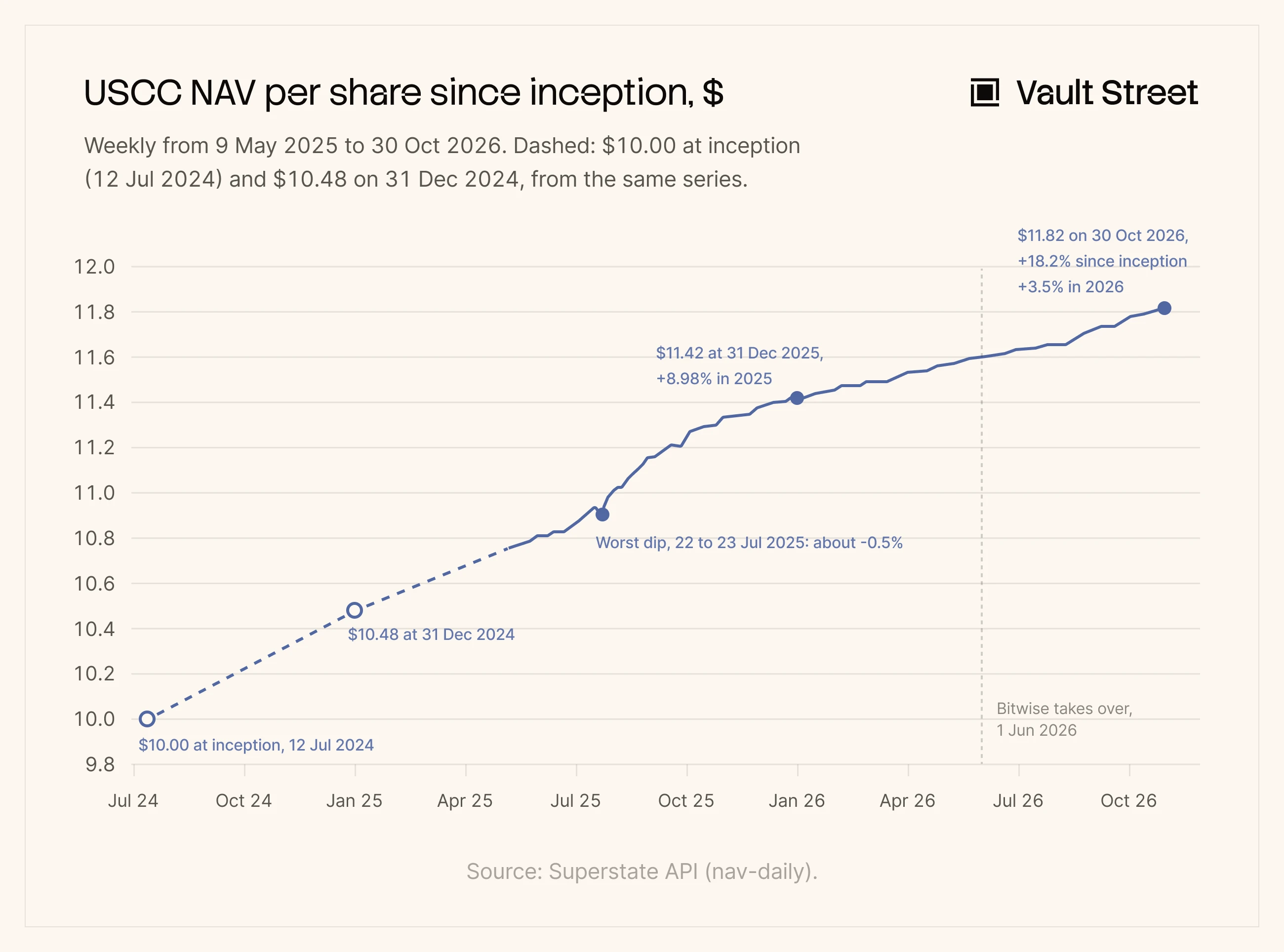
Return is realised in the NAV; there are no distributions. These figures are computed by Vault Street Research from the public NAV series. Past performance is not a guide to future results. Source: the Superstate API series (daily, 12 July 2024 to 30 October 2026):
| Metric | Value |
|---|---|
| NAV per share | $10.00 (12 July 2024) to $11.819958 (30 October 2026) |
| Since inception | +18.2%, 7.54% annualised |
| Calendar 2025 | +8.98% |
| Twelve months to 30 October 2026 | +4.31% |
| 2026 year to date | +3.53%, 4.25% annualised |
| Trailing 90 days | 5.64% annualised |
| Trailing 30 days | 4.67% annualised |
| Daily behaviour (to 15 September 2026) | Mean +2.0bp a day, standard deviation 6.4bp; 171 of 795 days negative (21.5%) |
| Worst single day | −0.449% (22 July 2025) |
| Worst drawdown | −0.484% (21 to 23 July 2025), recovered within days |
| Realised volatility | 1.22% a year |
The NAV falls on about one day in five because the futures are revalued every day (see Rate risk). The dips are small and recover within days. For the same reason, a 30-day return can mislead, and the year-to-date and one-year returns give a fairer picture.Superstate and Bitwise each publish a 30-day yield for USCC, and the figures do not agree. Superstate's fund page showed 4.63% on 30 October 2026, close to the NAV's own return. Bitwise's fact sheet showed 3.92% for September, below what the NAV returned that month. We could not find the reason for the gap, so this note uses the NAV.
30 days
Fees & Economic Drift
| Fee | Detail |
|---|---|
| Management fee | 0.75% a year on average daily NAV, accrued daily, paid monthly in arrears |
| Performance fee | None |
| Subscription and redemption fees | None today |
| USTB layer | Cash parked in USTB bears USTB's own management fee (0.15%, with the standard large-holder rebate) on top of the 0.75%. USTB was 20.3% of assets on 30 October 2026 |
| Holder-borne costs | Gas on burns and transfers; USDC to USD conversion through Circle on Circle's terms |
Total cost in context. USCC charges a 0.75% management fee and no performance fee, and its fact sheet gives a 0.95% expense ratio including other expenses (30 September 2026). In the coverage universe the tokenised Treasury funds cost 15bp (USTB) and 25bp (JTRSY), and the tokenised AAA CLO fund JAAA about 56bp all-in. USCC's extra cost bought about 4.5 points of return over Treasury bills in 2025 and under 1 point so far in 2026 (4.3% annualised against roughly 3.3% to 3.6% on tokenised bills). There is no tokenised basis-trade fund in the coverage universe to compare fees against directly.
Subscription, Redemption & Liquidity
Subscription and redemption mechanics
Investors complete onboarding in Superstate's investor portal, sign the Investment Agreement once approved, register wallet addresses to the allowlist, then fund by USD wire or USDC on Ethereum, Solana or Plume. Cash received by 5pm ET on a Market Day is priced at that day's NAV and shares are issued the next Market Day, as tokens minted to the allowlisted address or as book-entry. There is no atomic on-chain mint: USDC sent on chain is settled first and the shares are minted afterwards, and the token's own subscribe function has never been enabled. For redemptions, token holders call the burn function or send tokens to the fund's redemption address; either emits an OffchainRedeem event that the transfer agent's systems watch and treat as the request. Book-entry holders request through the investor portal. Payout is USD to a bank account or USDC to an Ethereum or Solana address.
Settlement timelines
Requests received by 5pm ET settle T+1 and later requests T+2 (per Superstate docs). Neither timing is guaranteed.
Demonstrated exit capacity
USCC has no instant redemption and no real secondary market, so holders exit by redeeming with the fund. Superstate's instant-redemption contract covers USTB but not USCC, and third-party venues do not fill the gap: on 23 September 2026, Upshift's redemption pool held about $200,000 and Fission did not list USCC.The fund's redemption record is strong:
- Largest single day: $100M, settled T+1 (per Bitwise, October 2026).
- Sustained outflows: shares outstanding fell 31% between 1 and 20 February 2026 (Superstate API).
- On chain: 85.4M shares redeemed across 446 transactions (on-chain inspection, 15 September 2026).
Under the published terms, redemption proceeds are paid in USD or USDC, and the manager may temporarily suspend redemptions or payments. We found no public notice of a suspension since launch.
Holder base and concentration
As of 1 November 2026 (superstate.com), 45.6% of shares are in book-entry, 39.7% on Ethereum, 11.6% on Plume and 3.1% on Solana. Aave Horizon's aUSCC contract holds 2.55M shares, about 17% of the 15.19M shares outstanding (Superstate API), down from 5.09M on 2 October. The Kamino and Morpho positions are negligible. On Ethereum the Horizon position is nearly half of the chain's supply. The fund's AUM path reflects a few large holders: $623M at the November 2025 peak after a $100M allocation from Spark was announced in October, $124M at the August 2026 low, and $180M on 30 October 2026.
Suspension, gating, and discretionary triggers
The manager's powers are listed in the governance table. They are drafted wide. The token has been paused once, from 16 July to 15 October 2024, in the launch period under the previous owner (verified by on-chain inspection). If the token is paused, no new burn can be submitted until it is unpaused (per the Zellic threat model, February 2026).
Smart Contracts & Technical Architecture
All addresses were verified by on-chain inspection at Ethereum block 25983142 (15 September 2026) and re-checked on 23 September 2026 after the allowlist swap, cross-referenced against Superstate's smart-contract documentation.
| Component | Address | Notes |
|---|---|---|
| USCC token (Ethereum) | 0x14d6...020c | OpenZeppelin TransparentUpgradeableProxy. Implementation 0x7e90...4feF, FundToken v1.3.0. Nine upgrades since July 2024. 6 decimals |
| Token ProxyAdmin | 0x2Bb7...AF3D | Owner 0x8abC...bDd1, an externally owned address (a single key, not a smart-contract multisig) whose key Superstate manages in Turnkey. It is also the token owner and holds mint, admin-burn, pause, accounting-pause, setAllowlist, setOracle and setRedemptionContract. No timelock. The same address controls the Plume deployment |
| Allowlist (Ethereum), live since 22 September 2026 | 0xBcBC...8D1f | TransparentUpgradeableProxy; implementation 0x2151...3B93, AllowlistV4_2 (Zellic, June 2026). Owner 0x7747...b2Fe, a second externally owned address, separate from the token owner and also managed in Turnkey; the same owner as the retired allowlist 0x02f1...38E5. ProxyAdmin 0xbd09...bd46. Permissions are per wallet per token |
| Aave Horizon aUSCC | 0x08b7...cb80 | RwaAToken holding USCC on Horizon (Aave address book). Passes the new allowlist's check (checkAllowlist returned ALL_ALLOWED, 23 September 2026) |
| NAV feed used by Aave | 0x19e2...5962 | EACAggregatorProxy over OCR2 aggregator 0x2d7C...3c58; owned by a 4-of-9 Safe 0x21f7...73CA able to repoint the aggregator with no delay; read by Aave through ScaledPriceAdapter 0x14CB...7230 |
| NAV feed used by Morpho | 0xAfFd...00d9 | Separate Chainlink feed, no staleness check on the Morpho side |
| Plume token | 0x4c21...54Cf | Byte-identical FundToken v1.3.0. Allowlist 0x2E55...d88c since 22 September 2026 |
| Solana mint | BTRR3s...UCaK | Token-2022 with default-frozen accounts and a permanent delegate. Allowlist program HFkKyw...RtfA; program source unverified; mint and upgrade authorities are single keypairs |
Allowlist and transfer control
The token checks both sender and receiver against the allowlist on every transfer, mint and burn, and a failing check reverts. Superstate adds only addresses that have passed KYC and signed the Investment Agreement, and may add audited DeFi protocols at its discretion. On 22 September 2026 Superstate replaced the EVM allowlists with new AllowlistV4_2 contracts. The permissions were copied across in 71 batch writes and the token was repointed with setAllowlist, a single owner transaction. The token's allowlist pointer and the Aave contract's permission were both verified on the new contract on 23 September. On Solana, accounts are frozen by default and thawed on onboarding through the allowlist program, which also holds a permanent delegate able to move or burn tokens from any account.
Upgradeability and admin key control
Both EVM tokens and both allowlists are upgradeable proxies controlled by the two owner addresses above: one key for the token and its upgrades, a separate key for the allowlist. Neither sits behind a timelock or an on-chain multisig. The Ethereum token has been upgraded nine times, twice within 28 hours on 20 and 21 July 2026 in step with Plume. The Solana allowlist program can be upgraded by a single keypair. The keys are managed in Turnkey, which holds them in secure hardware rather than splitting them across parties as MPC does, and signs when a policy configured by Superstate is met (per Superstate security documentation). The token contract mints only to allowlisted addresses.
Oracle design and failure modes
The Aave path has no staleness or deviation guard, so a late or missing print leaves the market valuing collateral at the last published NAV until the next print lands. The feed's 4-of-9 Safe can redirect the aggregator with no delay. Integrators should run their own print-arrival check against the public API.
Audit history, incidents, and bug bounty
Superstate publishes audits from ChainSecurity, Macro and Zellic. The two Zellic reports are the most relevant to USCC today:
- February 2026: a full review before the current contracts went live. Six findings, none above low. The four low-rated ones are in code USCC does not use. All but one were fixed.
- June 2026: a review of the token and allowlist upgrade. One medium-rated finding, fixed before deployment: the upgrade could have switched minting and burning back on if it ran while those were paused.
Neither review covered key management, infrastructure or the website. The live token, v1.3.0, was deployed in July 2026, one day after the reviewed v1.2.0. No exploit or loss on the USCC contracts is known. Superstate has a responsible-disclosure policy but no paid bug bounty, which both Zellic reports recommend adding.
Cross-chain model
There is no bridge. The token's bridge function is a burn that emits an event, after which Superstate mints on the destination or credits the register; nothing is atomic or verifiable across chains. In practice the chains are served through issuance: investors pay USDC on Ethereum, Solana or Plume and receive USCC on any of the three or in book-entry, and redeem on Solana for USDC on Ethereum or Solana. The transfer agent's register reconciles book-entry plus the three chain supplies to the 15.19M shares outstanding (Superstate API, 30 October 2026).
Operational Dependencies & Resilience
- Manager (Bitwise): portfolio management.
- Trust Administrator and transfer agent (Superstate Services): investor portal and onboarding (including AML screening), allowlist, minting, burn monitoring and every contract owner key; the operational single point for the token.
- NAV agent (NAV Consulting): the daily NAV, with no redundancy described in the public materials.
- Custodian (Anchorage): spot and staked assets.
- FCMs: the hedge and its margin.
- Oracle layer (Chainlink, 4-of-9 feed Safe): the price Aave Horizon liquidates against.
- Stablecoin rail (Circle): USDC settlement; redemption proceeds are paid in USD or USDC (per Superstate docs).
No business continuity or disaster recovery disclosure is published (confirm directly).
Network Availability & Cross-Chain
USCC exists on Ethereum, Plume and Solana. Ethereum carries 39.7% of shares and every DeFi integration that matters at scale. Book-entry carries 45.6%, so nearly half of holders can redeem without touching a chain. Plume (11.6%) is a byte-identical deployment controlled by the same owner address. Solana (3.1%) is a Token-2022 mint under single-keypair authorities.
Conclusion
USCC has been in fact under the Vault Street team's coverage since January 2025, and was used as an allocation from Resolv's USR stablecoin. It has proven as one of the first real composable DeFi use cases of an actively traded strategy fund, with consistently conservative allocations.It is a cyclical instrument, benefitting most during the bull phases of crypto markets, however its performance is controlled by increased allocations into t-bills when the basis trade does not outperform.On the product side, Superstate maintains one of the tightest fund and technology stack in the tokenization markets, and we have been increasingly comfortable with it over time. On smart contract monitoring, an item that makes sense to control is upgradeability of smart contracts, as there is no timelock.We like a combination of USCC's liquidity and leverage markets penetration, so that the instrument is a good candidate for medium-term allocations by conservative investors, such as (overcollateralized) stablecoin and vault backing, and company treasuries.
Disclaimer
This document is a research note prepared for informational purposes only. It is not investment, legal, tax, or accounting advice, and it is not an offer to sell or a solicitation to buy any security. Any offer is made only through the fund's offering materials to eligible investors. Figures and parameters are as of the dates indicated and are subject to change. This note draws on issuer and third-party sources that have not been independently audited, and is qualified in its entirety by the fund's governing and offering documents, which prevail in the event of any inconsistency. The views expressed are those of Vault Street Research and have not been approved or endorsed by Bitwise or Superstate. Prospective investors should review the offering materials and consult their own advisers.